Ferrari’s opening to their first home race of the season – and the beginning of the European tour – hasn’t exactly gone to plan.
After clear signs of frustration from both drivers in the opening two practice sessions, the question remains: Are the new upgrades on the SF-25 enough to reverse what’s been a disappointing start to 2025?
Not the weekend start Ferrari were hoping for
Ferrari arrived at Imola – just down the road from their Maranello base – with high expectations and the hope of making a statement in front of the tifosi.
Imola is traditionally where teams bring major upgrade packages, and after a dismal first quarter of the season, all eyes were on the Scuderia to deliver a turnaround.
However, the package brought to the track wasn’t as substantial as many had hoped. The most likely reason is the incoming technical directive, which will take effect from the Spanish Grand Prix. Ferrari seems to have chosen to delay major updates until they can fully adapt to the new regulations.
The current upgrades include a revised rear corner layout, as well as tweaks to the geometry of the rear wing and beam wing – aimed at improving how the car adapts to track-specific traits.
After FP1, the gap between Hamilton and fastest man Piastri was just 0.096s – in fact, Hamilton was quicker for much of the lap.
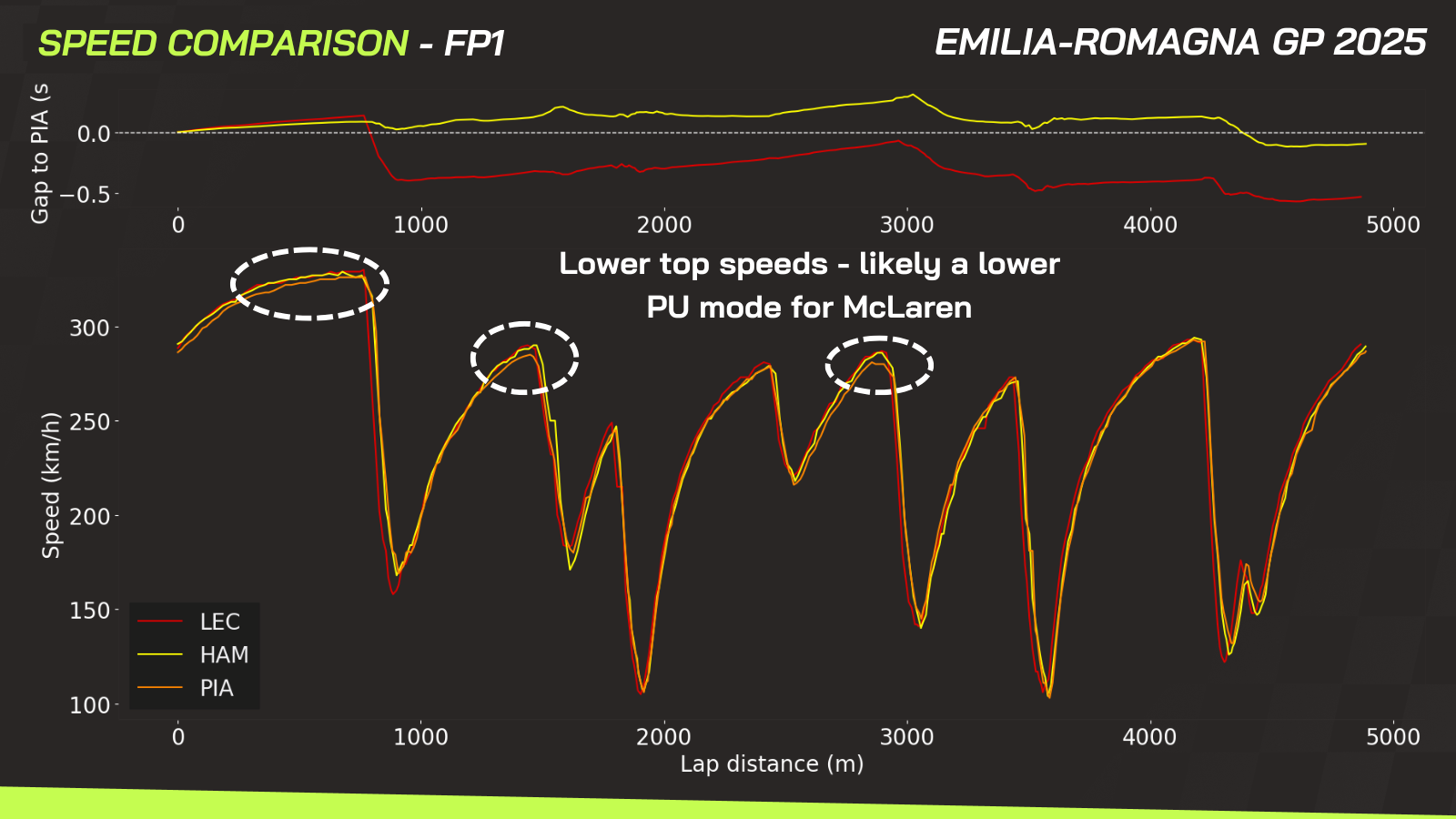
That said, FP1 results should be taken with a pinch of salt. Telemetry suggests McLaren weren’t using full deployment from their power unit, and the track conditions weren’t particularly representative either.
By FP2, we had a clearer picture – and unfortunately for Ferrari fans, the performance difference between the SF-25 and the MCL39, currently the quickest car on the grid, was evident. Leclerc finished as the quicker of the two Ferrari drivers, but even then, he was 0.475s adrift in P6.
More F1 uncovered ahead of Imola:
👉 Why Red Bull’s big RB21 Imola upgrade will have everyone taking note
👉 Small upgrades, big gains? Mercedes introduce a handful of new components at Imola
Ferrari’s struggles in key corners
Ferrari’s main weaknesses were exposed in Turns 3 and 9, where the car’s unstable rear end became difficult to manage.
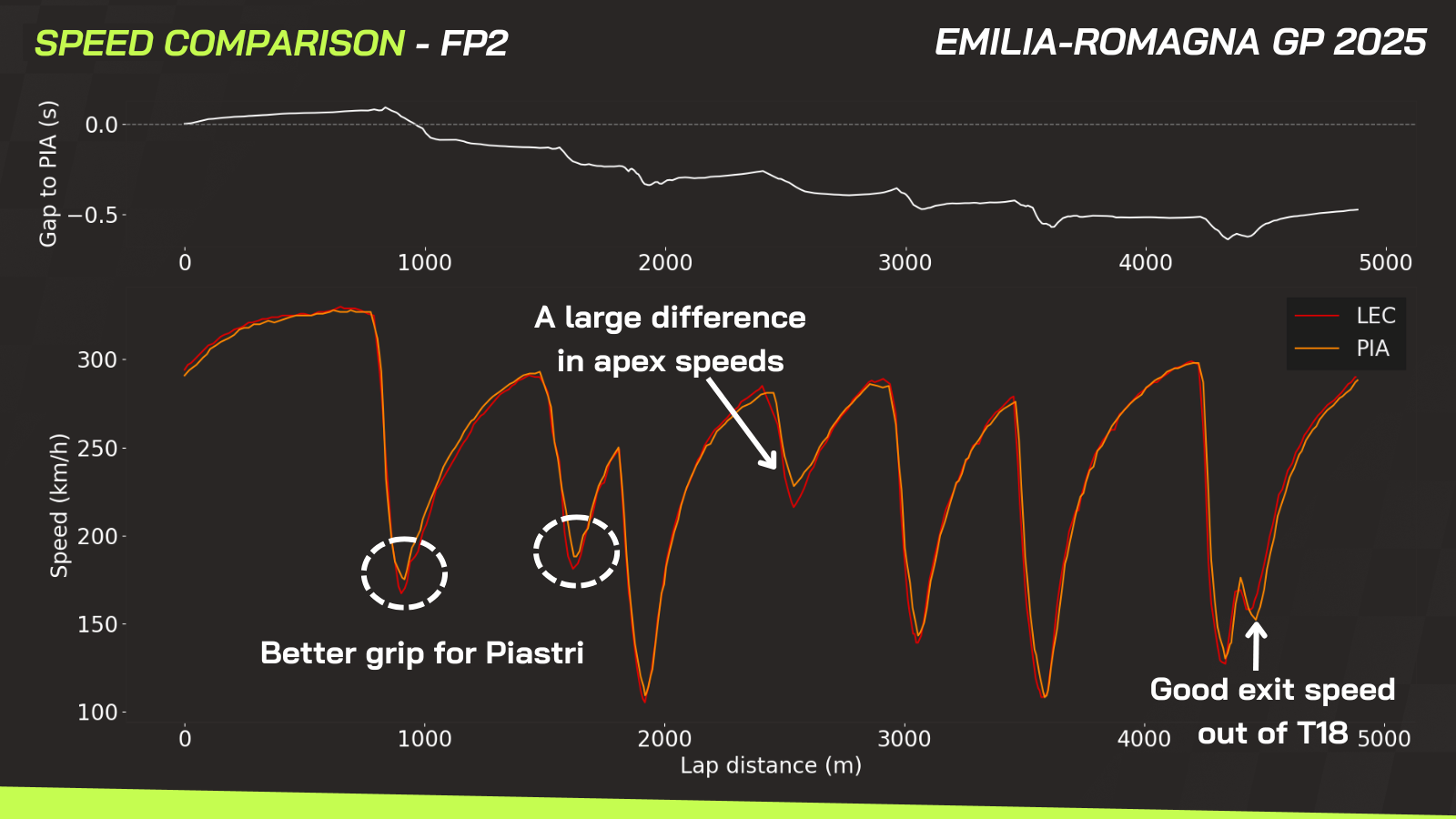
The data shows Leclerc struggling badly on the exit of Turn 3 – a fast, rear-limited corner – where he immediately began losing time to Piastri. Turn 9, Piratella, is another technical, medium-speed corner where the difference in apex speed between the two was over 10 km/h – a massive margin at this level.
Leclerc specifically pointed out in FP2 that the team needs to improve entry stability into Turns 5, 7, and 11 – all of which demand rear-end grip and composure.
One area where the SF-25 did look competitive was in Turns 17 and 18. These corners don’t punish rear instability as much, and Ferrari managed to keep the front tyres in their optimum window here, extracting solid grip. In fact, Leclerc was able to stay on throttle longer than Piastri through T18.
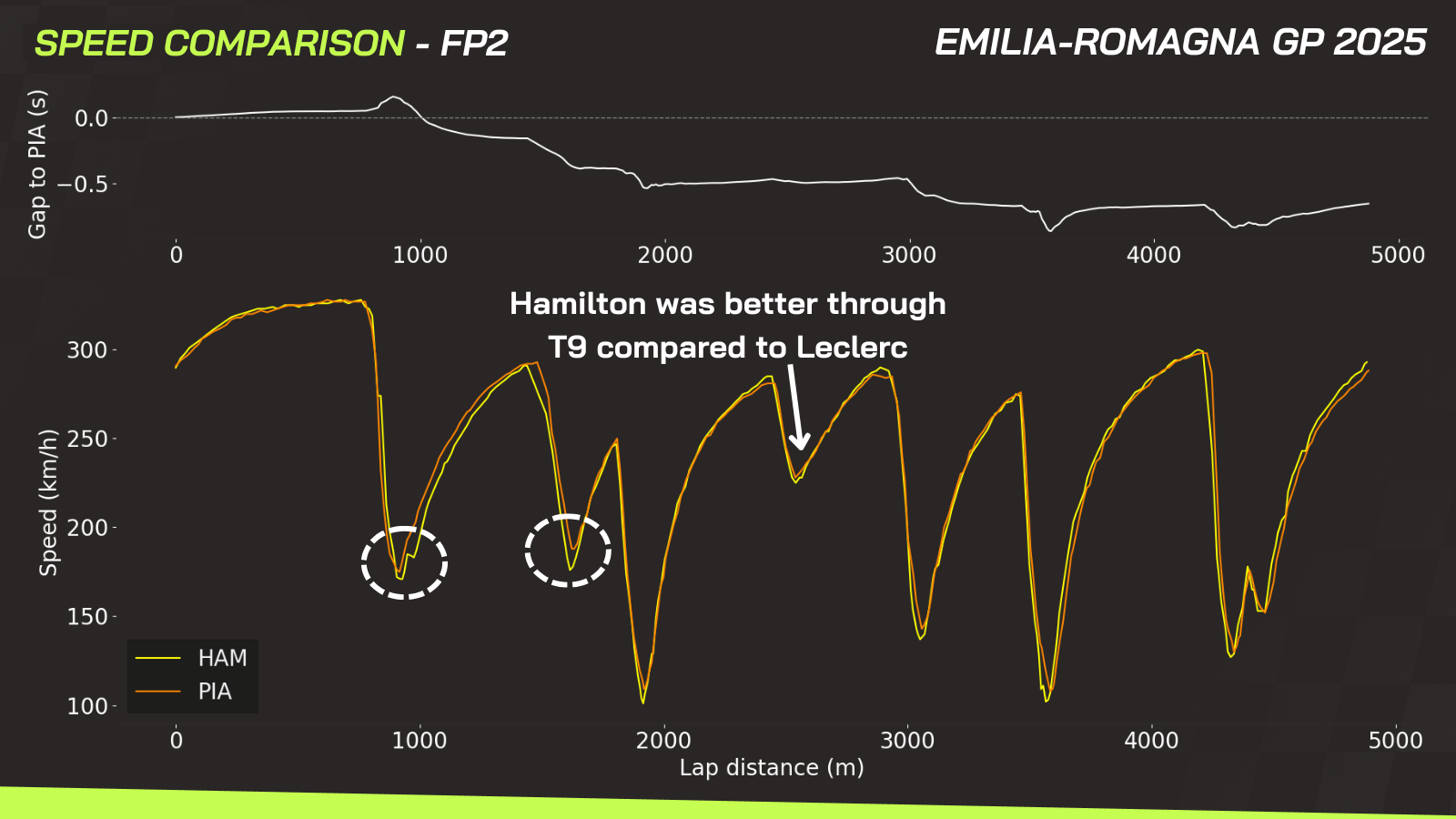
Comparing Hamilton to Piastri reveals a similar pattern, though Hamilton managed to better control oversteer through Turn 9.
Perhaps the most telling signs were the team radio messages, particularly during FP2, where both drivers expressed frustration, most notably about the braking.
One potential cause could be the altered brake setup teams use between warm-up and push laps. Why? Because brake heat plays a vital role in bringing tyres up to temperature, and teams often adjust brake balance or cooling to improve rear tyre warm-up.
It’s possible Ferrari’s engineers were experimenting with different configurations.
Ferrari’s rear-end problem persists
Ferrari’s rear-end weakness has been present since pre-season testing, and the team has yet to find a reliable solution.
There are many theories, but one thing is certain: the rear suspension is not effectively translating downforce into usable grip – not in the way the engineers would like.
This is arguably the root cause of Ferrari’s underwhelming season so far. Their poor qualifying pace keeps them away from the front – even though their race pace isn’t bad.
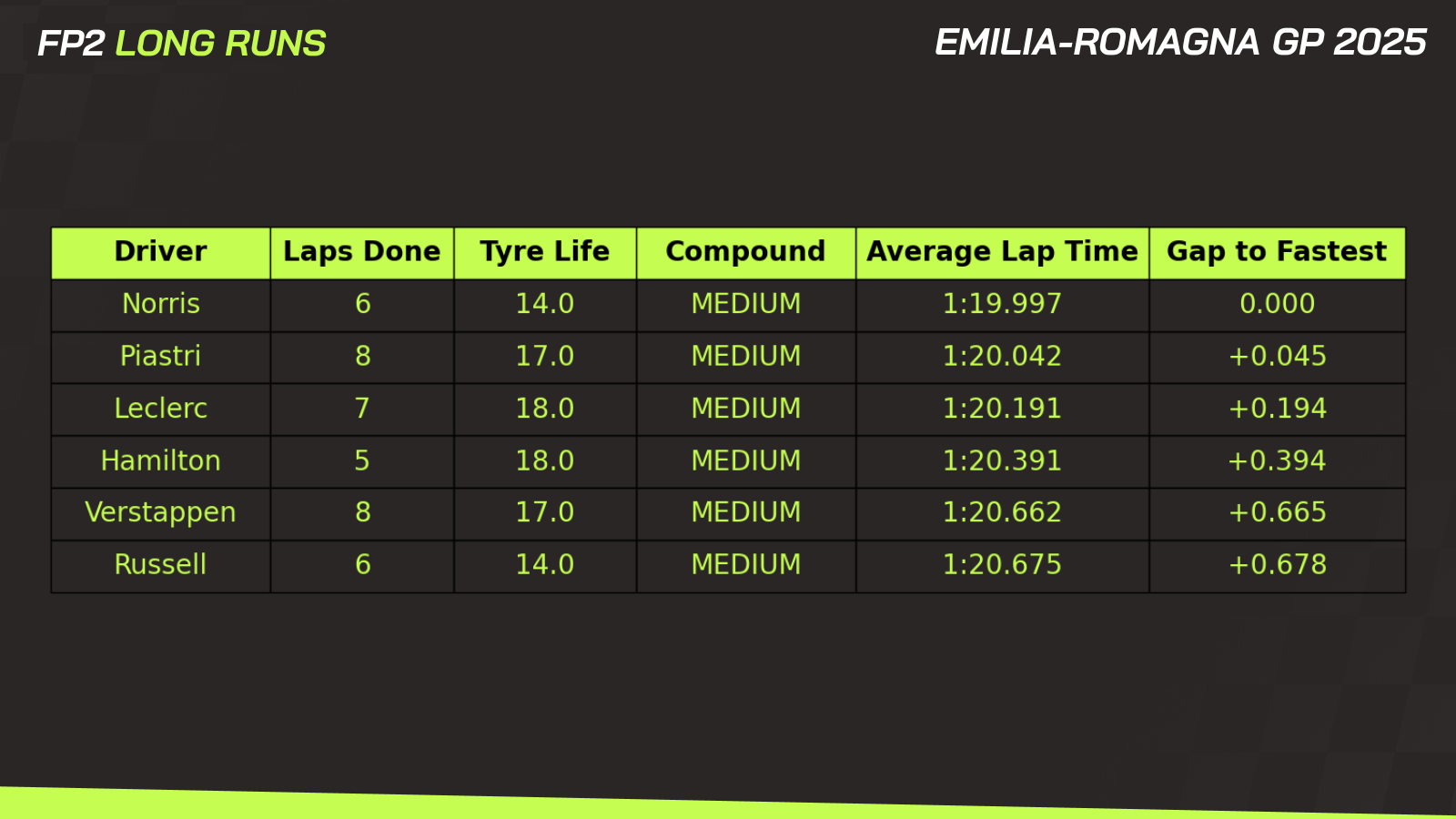
That’s supported by long-run simulations from FP2. After McLaren, who were clearly in a class of their own, Ferrari were next-best. Leclerc was just 0.194s off on average – a noticeable but not catastrophic gap. The difference becomes more apparent when compared to Red Bull and Mercedes.
What can we expect from Ferrari in Imola?
Qualifying will be absolutely critical. And truth be told, things don’t look too promising. Imola only offers one real overtaking opportunity – the first corner, after the sole DRS zone.
Which means that even if Ferrari’s race pace is respectable, it won’t matter much if they qualify poorly. Making up ground in the race could prove nearly impossible.
Read next: Data revealed: Can Red Bull Racing’s Imola upgrades bring the heat to McLaren?
