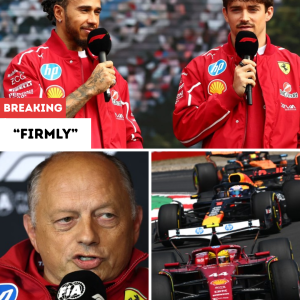
There are certain days in the high-octane world of Formula 1 that feel fundamentally different—days when the fog of uncertainty lifts, and a new reality sharpens into focus. January 27th in Barcelona was one of those rare, pivotal moments. While the paddock awoke to looming rain clouds and the tentative energy of a new season, Ferrari didn’t just show up to the first private testing of the 2026 regulations; they arrived to send a message so loud that even the famously stoic garages of Red Bull and Mercedes had no choice but to listen.
The headlines, however, aren’t just about the lap times. They are about a specific, electrifying moment that fans and critics alike have been waiting for: Lewis Hamilton’s debut behind the wheel of the Ferrari SF26. The seven-time world champion, fresh from a transition that shook the sport to its core, offered a glimpse into the Scuderia’s future—and if his “leaked” reactions are anything to go by, the rest of the grid should be very, very worried.
The Prancing Horse Gallops in the Rain
While rival teams like Mercedes and Alpine chose to sit out the morning session, unwilling to risk their untested machines in the wet, Ferrari didn’t flinch. At exactly 9:00 a.m., the SF26, equipped with the brand-new PU676 power unit, rolled onto the tarmac. The engine didn’t sputter or hesitate; it purred with the menacing confidence of a predator in its element.
Charles Leclerc took the morning shift, and the data he produced was nothing short of staggering. In an era where reliability is the ghost that haunts every opening test, the SF26 ran without a single mechanical hiccup. Leclerc clocked 64 laps before lunch—nearly a full Grand Prix distance—providing a stark contrast to the stuttering starts often seen under radical new regulations.
But the real shock came when the skies opened up. In low-grip conditions that typically turn F1 cars into ice skates, the SF26 looked glued to the track. Leclerc posted a wet lap of 1:32.88. For context, Max Verstappen’s best effort in similar conditions was a full six seconds slower. While testing times are notoriously difficult to decipher due to fuel loads and engine modes, a gap of that magnitude is rarely accidental. It speaks to a chassis that possesses inherent balance and mechanical grip—the “holy grail” for any driver chasing a championship.
Hamilton’s Historic Debut: “It Wants to Go Fast”
As the track began to dry and other teams remained shuttered in their garages, the moment arrived. Lewis Hamilton stepped into the cockpit of a Ferrari, not for a photo op, but to drive. The sight of the British legend in red is still jarring to some, but his performance was seamless.
Observers noted that Hamilton wasn’t fighting the car. There were no frantic steering corrections, no lockups, and no hesitation. He looked, for the first time in years, completely at ease.
Breaking his silence after the run, Hamilton’s comments—caught in quiet conversation with engineers—offered a terrifying prospect for his former team. “This car feels different,” he reportedly said, a glint of genuine excitement returning to his eyes. “There’s a calm underneath it like it’s ready.”
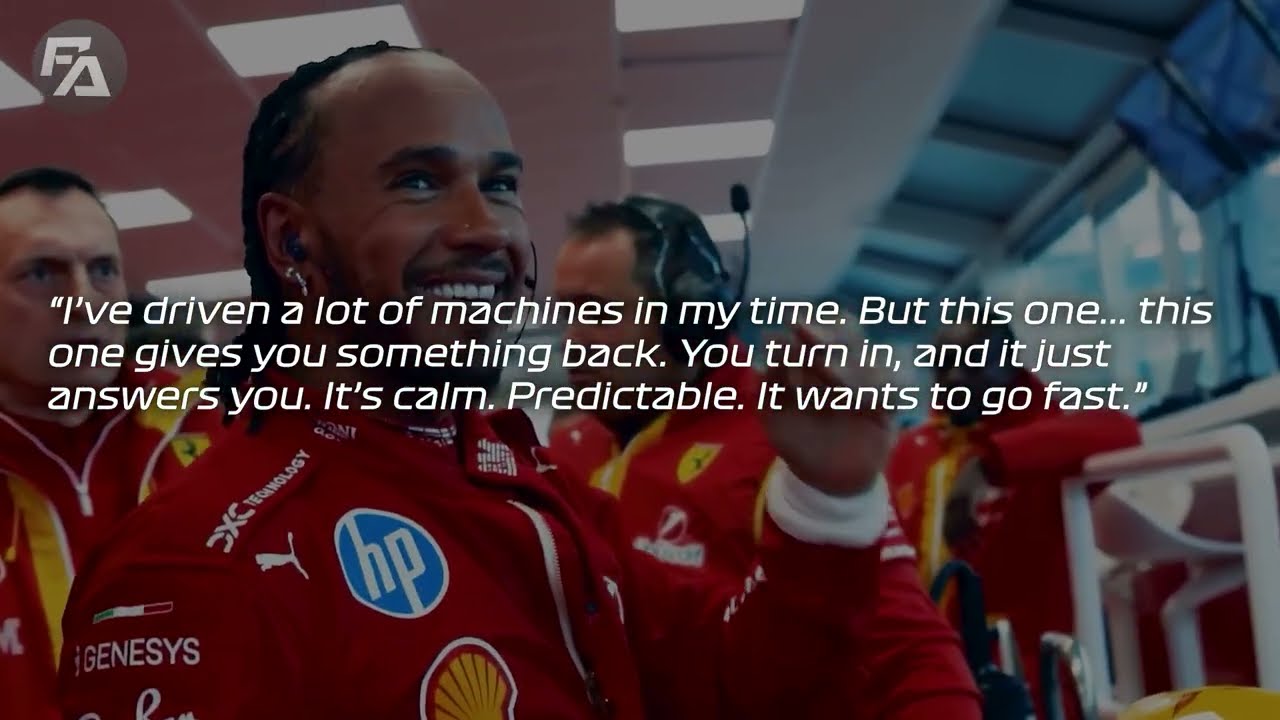
Later, speaking with temporary race engineer Bryan Bozzi, Hamilton expanded on the feeling that has eluded him during the difficult ground-effect era. “I’ve driven a lot of machines in my time, but this one… this one gives you something back. You turn in and it just answers you. It’s calm, predictable. It wants to go fast.”
This is not just driver feedback; it is a confirmation that Ferrari may have solved the driveability issues that plagued their 2025 campaign. For a driver of Hamilton’s caliber, a predictable front end is the key to unlocking elite performance.
Technological Triumph: Active Aero and the PU676
Beyond the driver feedback, the technical leap Ferrari has taken appears immense. The 2026 regulations introduced complex active aerodynamics, a feature that many predicted would cause initial headaches. Yet, on the main straight of the Circuit de Barcelona-Catalunya, the SF26’s rear wing opened and closed to cut drag with flawless precision.
Furthermore, the new PU676 engine is already drawing praise from customer teams like Haas and the incoming Cadillac entry. It is fast, solid, and reliable—three words that Ferrari fans have been desperate to hear in the same sentence.
By running in the rain while Mercedes saved their testing allocation, Ferrari gathered double the data: dry performance, wet handling, tire degradation, and aerodynamic response in high humidity. They now possess a baseline of performance metrics that their rivals simply do not have.
A Warning Shot to the Grid
As the session wound down, Hamilton parked the SF26 and delivered a final radio message that might well define the narrative of the pre-season: “This thing’s got teeth. Let’s sharpen them.”
It was a statement of intent. The uncertainty that clouded Hamilton’s final years at Mercedes appears to have evaporated, replaced by the ruthless focus of a man chasing an eighth world title. Ferrari, a team often criticized for strategic blunders and fragility, looked operational, sharp, and aggressive.
Of course, testing is not racing. Red Bull is watching, and Mercedes is undoubtedly plotting their countermove. But in Barcelona, under the grey winter skies, the signal was clear. The Prancing Horse is no longer just participating; they are hunting. And with Lewis Hamilton holding the reins, the 2026 season promises to be a battle for the history books.