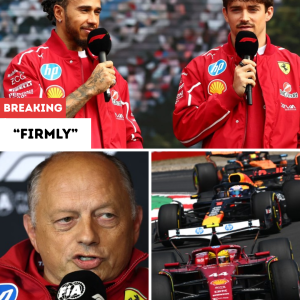
Five days. That’s all it took to turn the Formula 1 narrative completely on its head. For an entire winter, the paddock has been filled with polite whispers and cautious optimism. But as the engines cooled in Barcelona this week, the silence was shattered—not by a press release, but by a single lap time that no one, perhaps not even the Tifosi, saw coming.
A 1:16.348.
It was the fastest time of the week. But the number on the timing screen mattered less than the name next to it: Lewis Hamilton.
Just twelve months ago, the idea of Hamilton topping a timesheet seemed like a fading memory. His 2025 season was, to put it bluntly, a disaster. It was a year where the seven-time champion didn’t just lose; he looked lost. For the first time in his 19-year career, he finished a season without a single podium. He was out-qualified by his teammate 19-5. He described himself as a “passenger” in a car that refused to cooperate with his legendary driving style.
Critics whispered that the magic was gone. They said the sport had moved on. They were wrong.
The Gamble That Saved a Legacy
To understand the magnitude of what happened in Barcelona, we have to rewind to April of last year. Ferrari Team Principal Frédéric Vasseur made a call that, at the time, looked borderline reckless. He completely froze development on the 2025 car. While McLaren and Red Bull were fighting for scraps of glory, Ferrari effectively gave up.
Vasseur diverted every single wind tunnel hour, every euro of the budget cap, and every ounce of engineering brainpower toward one thing: The 2026 Regulations.
It was a strategy that demanded humiliation in the short term for the hope of domination in the long term. It meant accepting that 2025 would be a failure. It meant watching Hamilton struggle with a “bad” car, knowing help wasn’t coming. But in Barcelona, that gamble began to pay out.
Why the 2026 Rules Are Hamilton’s Best Friend
The 2026 technical regulations have torn up the rulebook. The cars have 30% less downforce. They are lighter. The power units are now a massive 50/50 split between internal combustion and electric power. Active aerodynamics have replaced DRS.
Early simulator reports were grim. Charles Leclerc, a man who lives on the ragged edge, initially called the new driving experience “not a fan.” He described a car that forced you to think more than drive—a high-stakes game of energy management rather than pure speed.
But on the track? The reality was different. The new cars are lively. They are, in the words of the drivers, “oversteery, snappy, and sliding.”
For a driver who grew up in the ground-effect era of the early 2020s—where cars had to be driven flat and smooth like they were on rails—this is a nightmare. But for Lewis Hamilton? This is home.
Hamilton’s driving genius has always been his ability to rotate a car. He loves a rear end that steps out. He loves to brake late, wrestle the steering wheel, and “catch” the slide on the exit. The stiff, heavy cars of 2025 punished him for this. The 2026 cars reward it.
“Actually a little bit more fun to drive,” Hamilton said with a grin that hasn’t been seen in years. He described the car as “catchable.” For the rest of the grid, a sliding car is a problem to be fixed. For Hamilton, it’s a weapon to be used.

The “Ghost Car” and the Whisper of “Ducts”
However, don’t go placing your bets on a Ferrari championship just yet. The drama is only beginning, and it’s getting political fast.
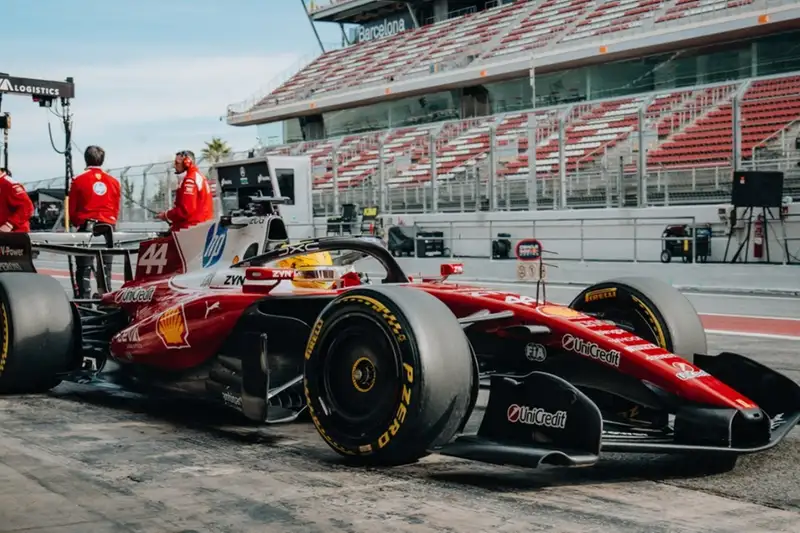
The Ferrari SF-26 that Hamilton drove to the top of the charts in Barcelona? It wasn’t the real car.
Sources indicate that the chassis running in Spain was a “ghost”—a baseline specification designed to gather data and survive the shakedown. The actual race-spec aerodynamic package is sitting under covers in Maranello, waiting to be unleashed at the final test in Bahrain.
But even this “simplified” version has raised eyebrows. Rival teams have spotted something. The word “duct” is being whispered in hospitality suites up and down the paddock. Ferrari’s aerodynamic concept has reportedly caught the attention of the FIA, with inspectors lining up to take a closer look at a design described as “borderline aggressive.”
We have seen this movie before. A team finds a loophole (remember the Brawn GP double diffuser? The Mercedes DAS system?), the FIA investigates, and the rest of the grid panics. If Ferrari’s “ghost” car is this fast, what happens when the real aero-package arrives? Or, more terrifyingly for the Scuderia, what happens if the FIA bans their golden ticket before the first light goes out?
The Rivals: Sleeping Giants?
While Ferrari grabbed the headlines, Mercedes quietly went about their business. They didn’t chase lap times; they chased reliability. George Russell and the Silver Arrows completed a staggering 500 laps (over 2,300 km), winning the mileage war hands down. Their car looks complete. It looks dominant in its consistency. They are the team that never had the problem in the first place, and in a new era, reliability is often worth more than raw speed.
And then there is Red Bull. Max Verstappen’s best time was over a second slower than Hamilton’s. In previous years, this would be a crisis. But Red Bull are the masters of sandbagging—hiding their true pace until it matters. Yet, the silence from their garage was deafening. Was it confidence? or confusion?

The Verdict
We came into 2026 expecting a reset. What we got was a resurrection.
Lewis Hamilton is no longer a passenger. He is a protagonist. The man who looked defeated by the sport has found a machine that speaks his language again. Ferrari’s reckless gamble to sacrifice a year appears to have birthed a monster of a car.
But Formula 1 is never simple. As we head to Bahrain, the questions are mounting. Is the SF-26 legal? Can the FIA be convinced that Ferrari’s “aggressive” innovation is within the spirit of the rules? And is the “Ghost Car” a precursor to dominance, or a target for a ban that could ruin their season before it starts?
One thing is certain: The 2025 hangover is over. The politics, the speed, and the drama are back. And Lewis Hamilton? He’s right in the center of it all, exactly where he belongs.
Buckle up. 2026 is going to be a wild ride.