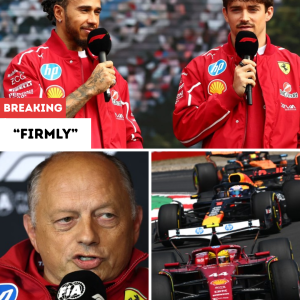
In the world of Formula 1, the stopwatch never lies, but it often tells only half the truth. When Lewis Hamilton crossed the finish line in Barcelona with the fastest time of the entire pre-season shakedown, the headlines wrote themselves. “Ferrari is Back.” “The King Has Found His Throne.”
To the outside world, it looked like the perfect start to the most anticipated partnership in motorsport history. But behind the closed doors of the garage, the mood was far from celebratory.
While the Tifosi cheered, rival engineers from Red Bull and Mercedes were looking at the telemetry, and they were smiling.
They saw what the timesheets didn’t show: a car dancing on a knife’s edge, a machine so unpredictable that it threatens to turn Hamilton’s dream move into a chaotic nightmare. The SF-26 is fast, yes. But in Formula 1, speed without stability is just a crash waiting to happen.
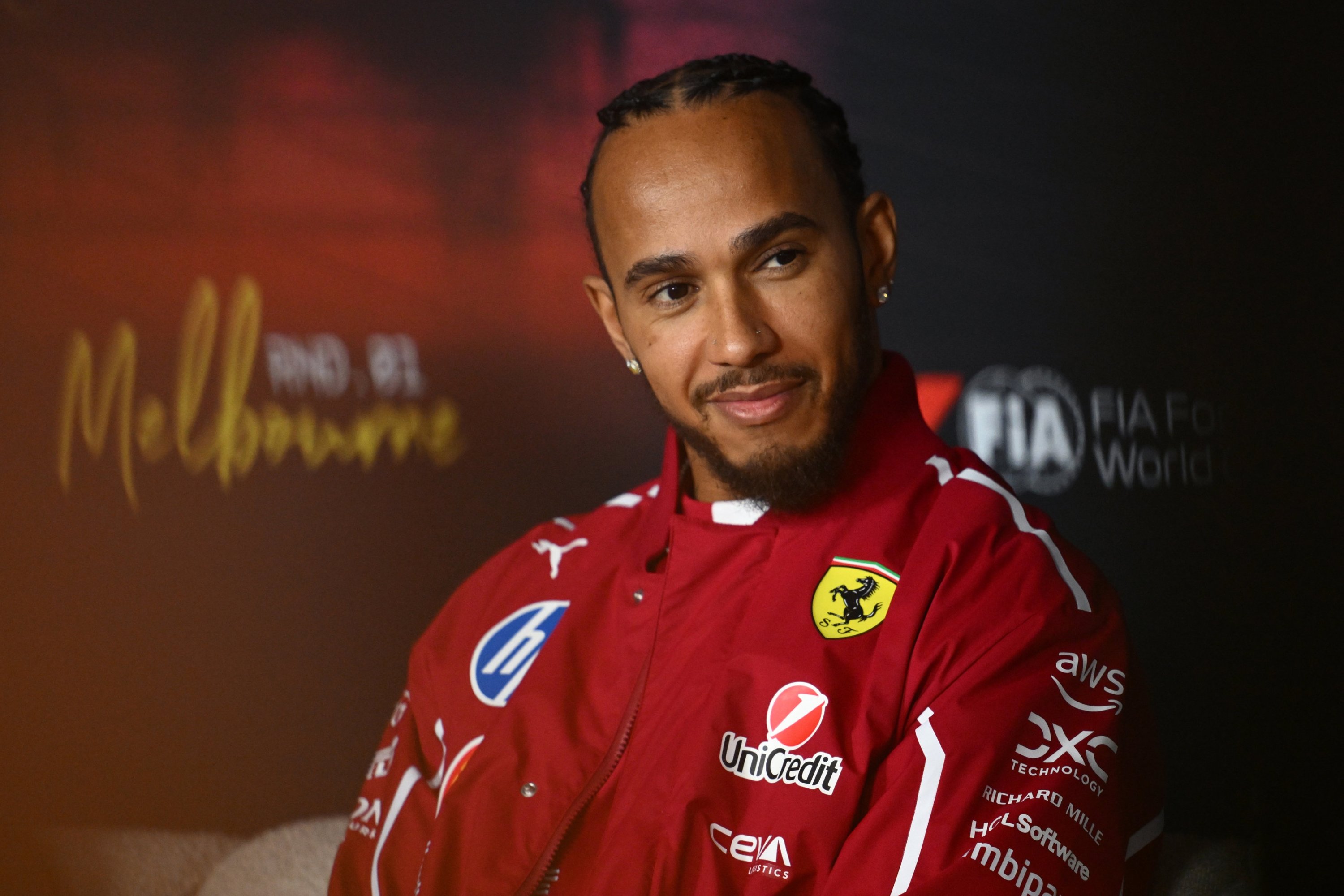
The “Caged Animal” Beneath the Bodywork
The 2026 regulations have birthed a new breed of F1 cars—lighter, more agile, and heavily reliant on active aerodynamics. Ferrari’s interpretation, the SF-26, is a masterpiece of weight saving, sitting just 2kg above the minimum limit. On paper, it is sharper than anything Hamilton has driven in years. But on the track, that sharpness has a bite.
Multiple sources reported that Hamilton experienced critical oversteer moments throughout the test. We aren’t talking about minor corrections; we are talking about a full loss of rear-end stability at medium speeds. The nadir came at Turn 10, where the car snapped into a 360-degree spin that left onlookers gasping. This isn’t the behavior of a championship-winning machine; it is the behavior of a car that doesn’t know what it wants to be.
The culprit appears to be the active aerodynamic system. Designed to adjust the front and rear wings independently to redistribute downforce, the system is cutting-edge but clearly unrefined. Hamilton discovered that the car’s balance shifts not just from track to track, but from corner to corner. Sometimes, it changes within the same corner depending on the hybrid system’s charging mode. For a driver like Hamilton, who built his legacy on the rock-solid predictability of Mercedes engineering, this inconsistency is terrifying.
The “Lift and Coast” Reality
If the handling wasn’t enough to worry about, the driving style required to extract lap time from the SF-26 is something most drivers despise. The 2026 engine regulations are heavily dependent on electrical energy, and the MGUK cuts out at 345 km/h. To keep the battery alive for a full qualifying lap, drivers are being forced to “lift and coast” even on their fastest runs.
Haas driver Esteban Ocon revealed the extent of this issue, admitting he had to lift off the throttle well before the braking zone just to ensure he had electrical deployment for the final corners. This is the exact style of driving that Charles Leclerc famously hated in 2025, exploding over the radio about 200-meter lift sequences. Now, Ferrari has built a car where that discipline isn’t just a strategy option—it’s mandatory. They have engineered a championship contender around a driving style their own star drivers loathe.

The Shell Fuel Gamble
Perhaps the most alarming secret of the Barcelona test was what was inside the car. It has emerged that the SF-26 never ran on its final, race-legal fuel blend. While the FIA granted temporary exemptions for testing, Ferrari chose not to run the mandatory 100% sustainable biofuel that will be required from Bahrain onwards.
This is a massive risk. Fuel chemistry is not a minor detail; it fundamentally dictates combustion efficiency and engine performance. While Mercedes (Petronas) and Aston Martin (Aramco) have been testing their sustainable fuels for months—with Aramco gathering a full year of data from Formula 2—Ferrari’s partner, Shell, is reportedly lagging behind. Paddock sources describe Shell’s biofuel as the “least advanced” among the major suppliers.
If the new fuel introduced in Bahrain doesn’t match the combustion characteristics of the blend used in Barcelona, all of Hamilton’s data becomes worthless. The handling balance, the engine mapping, the cooling requirements—everything could change. Ferrari is effectively walking into the first race of the season blind.
The Political War: Compression Ratios
Adding to the chaos is a looming legal battle. Ferrari, along with Audi and Honda, has accused Mercedes and Red Bull of exploiting a loophole in the engine regulations. They claim their rivals are using systems that expand under heat to increase the compression ratio from the legal 16:1 to a more powerful 18:1 during races.
This trick is estimated to be worth 10-15 horsepower. If the FIA doesn’t close this loophole, Ferrari is prepared to file a formal protest at the Australian Grand Prix. This means the 2026 season could begin not on the podium, but in the stewards’ room. It’s a high-stakes game of poker, and Ferrari is betting that the rulebook will save them if their engineering can’t.

Vasseur’s Deadline
All of this places immense pressure on Team Principal Fred Vasseur. He made the bold decision to abandon the 2025 season back in April to focus entirely on this car. He promised a revolution. Instead, he has delivered a fast but fragile machine with a fuel question mark hanging over it. Italian media reports suggest Vasseur has just five races to prove this gamble was worth it. If results don’t come early, the patience of the Ferrari board—and perhaps Hamilton himself—will wear thin.
Lewis Hamilton left Mercedes for a new challenge, and he has certainly found one. He has traded stability for potential, and predictability for chaos. As the teams pack up for the Bahrain test on February 11th, one thing is certain: the “fastest” car in testing has the longest road to travel. Judgment Day is coming, and Ferrari might not be ready for the verdict.