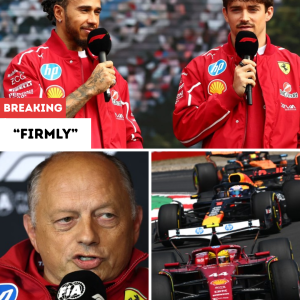
If Formula 1 was waiting for a warning shot ahead of 2026, Ferrari didn’t just fire one.
They detonated it.
On Day 2 of pre-season testing at the Bahrain Grand Prix venue, the Scuderia Ferrari delivered a performance so commanding that the entire paddock was left stunned — and perhaps slightly terrified.
Because this didn’t look like winter hype.
This looked real.
The Lap That Silenced the Grid


The number that changed everything:
1:34.273
That was the time set by Charles Leclerc in the Ferrari SF26 during the morning session.
Not just fastest.
Untouchable.
Over half a second clear of the field.
In modern Formula 1, gaps are measured in hundredths. A margin of 0.5 seconds isn’t an advantage — it’s an abyss.
Even more telling? Despite track evolution throughout the day, no one beat it.
Not even close.
Compared to Day 1’s benchmark from Lando Norris, Ferrari made what appeared to be a massive overnight leap.
And they did it without drama.
Red Bull & Mercedes: Crisis Mode
While Ferrari’s garage ran like clockwork, chaos unfolded elsewhere.
Red Bull Stumbles


The reigning powerhouse, Red Bull Racing, suffered a major hydraulic leak that derailed their morning session.
Young driver Isack Hadjar completed just a single lap before the issue forced the car back into the garage.
In testing, mileage is everything.
Lost laps mean lost data. Lost data means lost development time.
Even after returning for 58 afternoon laps, the damage was done.
Mercedes Nightmare


If Red Bull had a bad day, Mercedes AMG Petronas had a disaster.
Rookie sensation Kimi Antonelli managed only three laps before a terminal power unit failure required a full engine change.
Hours were lost.
Even when George Russell took over, the team barely reached 27 laps.
While rivals fought mechanical fires, Ferrari simply kept circulating.
Calm. Fast. Clinical.
The “Test Mule” Theory: Is Ferrari Hiding Even More?
Here’s where it gets unsettling.
Whispers in the paddock suggest the SF26 running in Bahrain may not even be Ferrari’s final-spec machine.
Some insiders claim it’s essentially a “test mule” — a baseline chassis focused on data validation rather than peak aerodynamic aggression.
If that’s true?
The grid has a problem.
Because if Ferrari is half a second clear with a conservative package, what happens when the real upgrades arrive?
This isn’t traditional sandbagging — going slow to hide pace.
This could be the opposite.
They might already be fast.
And still holding back.
The Verstappen Trick — And Why Ferrari Doesn’t Need It
A fascinating subplot emerged around driving techniques under the new 2026 regulations.
Many drivers were seen aggressively downshifting to first gear in slow corners — a method popularized by Max Verstappen — using engine braking to rotate the car and harvest energy.
Teams like McLaren and Alpine experimented heavily with it.
Leclerc?
He tried it briefly.
Then abandoned it.
Why?
Because the Ferrari appears to rotate naturally.
While others are forcing the car to turn, the SF26 seems inherently balanced — suggesting a mechanical platform already optimized for the new era.
That might be the most frightening sign of all.
The 2026 Engine War
The 2026 rules split power 50/50 between combustion and electric deployment — making energy efficiency crucial.
Telemetry suggests Ferrari’s new power unit is deploying electric power nearly the entire length of the straights.
That’s massive.
Meanwhile, reports suggest a potential engine loophole being explored by Mercedes has triggered political pushback from Ferrari, Red Bull, Honda, and Audi.
If regulatory adjustments come into play, it could further cement Ferrari’s advantage.
Even customer teams like Haas showed strong pace — reinforcing the idea that the Ferrari power unit is both fast and reliable.
Is This Finally Ferrari’s Era?
Ferrari fans know this story too well.
Fast in winter. Hopeful in March. Heartbreak by July.
But Bahrain felt different.
This wasn’t flashy.
It was controlled dominance.
-
Fastest lap by a margin
-
Bulletproof reliability
-
No visible weaknesses
-
Calm execution
As the sun set over the desert, the prancing horse cast a very long shadow over Formula 1.
The question isn’t:
“Is Ferrari back?”
It’s:
“How far ahead are they?”
Because if Day 2 was a preview…
The 2026 season may already have a favorite.