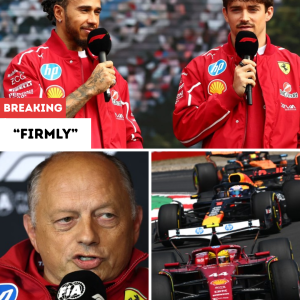
What if the most frightening development of the 2026 Formula One pre-season wasn’t a headline lap time…
but a pattern hidden deep in the data?
According to Nico Rosberg, something quietly shifted during the second week of testing in Bahrain.
We didn’t witness a seven-time champion struggling to adapt.
We witnessed Lewis Hamilton beginning to control a Ferrari.
And that, Rosberg suggests, is dangerous.
🎯 Why Rosberg’s Words Matter
When Rosberg analyzes Hamilton, the paddock listens.
He isn’t a commentator chasing clicks. He’s the 2016 World Champion — the only teammate who went toe-to-toe with Hamilton during the peak of his Mercedes dominance and walked away with the crown.
He knows what Hamilton looks like when he’s searching.
And he knows what he looks like when he’s building a title campaign.
After Bahrain’s second test week, Rosberg’s tone changed. Early on, he described Hamilton’s move to Ferrari as a complex adaptation process. But by the end?
He was talking about a driver already operating the car in its optimal window.
That’s a very different story.
🏜 Why Bahrain Reveals Everything
The Bahrain International Circuit is brutally honest.
-
Rear instability? The abrasive asphalt exposes it.
-
Poor traction? Tire degradation skyrockets.
-
Balance issues? The steering wheel tells the story instantly.
In week one, Hamilton admitted the struggles:
-
Low grip
-
Crosswinds destabilizing balance
-
A Ferrari SF26 demanding mid-corner corrections
It sounded exactly like what you’d expect from a driver adapting to a radically different machine under complex 2026 regulations.
But week two?
The tone — and the telemetry — changed.
📊 The Shift: From Experimenting to Executing
Ferrari stopped searching.
They started executing.
Rosberg’s analysis didn’t highlight a sensational qualifying simulation. Instead, he focused on something far more ominous:
Structural stability.
Hamilton’s long-run pace settled into a narrow, metronomic band.
-
No sudden tire temperature spikes
-
No sharp degradation cliffs
-
No erratic lap-time drop-offs
Just relentless consistency.
That level of repeatability doesn’t happen when a driver is still guessing.
It happens when he understands.
🎥 The Steering Tells the Truth
Onboard footage revealed something subtle — but chilling.
The frantic micro-corrections seen in week one? Gone.
Through heavy braking zones and slow-corner transitions, Hamilton’s steering inputs became progressive, fluid, calm.
That means one thing:
The rear of the car stopped surprising him.
And in Formula One, when a car obeys instead of betrays, the driver stops reacting…
and starts attacking.
🔥 Rosberg’s “Dangerous Connection”
Rosberg used a phrase that sent a ripple through the paddock:
“A dangerous connection.”
What does that mean?
Historically, Ferrari’s problem wasn’t peak speed.
It was operating window.
They could produce brilliance in perfect conditions — but small changes in temperature, wind, or tire wear would collapse performance. Drivers were forced into survival mode.
If Ferrari has widened that window —
and Hamilton has already positioned himself comfortably inside it —
the growth potential across a long season becomes terrifying.
Because development builds on stability.
And stability compounds.
🧠 The Psychological Edge
Rosberg understands this better than anyone.
When Hamilton drives smoothly, instinctively, without visible corrections, his internal confidence multiplies.
He doesn’t wrestle the car.
He shapes it.
That mental freedom is what separates adaptation from domination.
Most modern team switches take months of recalibration:
-
New braking references
-
New differential mapping
-
New hybrid deployment behavior
But by late February, Hamilton appeared to be driving on instinct.
That’s not adaptation.
That’s assimilation.
🏎 Why This Changes the 2026 Title Picture
The Bahrain test didn’t crown a champion.
Hamilton didn’t top the timing sheets in dramatic fashion.
There was no euphoric celebration from Maranello.
Instead, there was something more powerful:
Stability.
In pre-season testing, stability is worth more than a flashy lap time.
It suggests Ferrari has a fundamentally strong base.
It means upgrades will enhance — not repair.
And when a team like Ferrari spends a season optimizing instead of firefighting, their development curve becomes exponential.
For rivals like Red Bull, McLaren, and Mercedes, that’s the real warning.
🏁 Final Word
Rosberg isn’t predicting the championship.
He’s identifying a pattern.
He recognizes the moment when Lewis Hamilton stops learning a car — and starts molding it to his will.
That moment may have already happened.
The Bahrain desert didn’t deliver fireworks.
It delivered harmony.
And when a seven-time world champion finds harmony this early in red…
The entire grid feels it.
The connection has been made.
And psychological warfare has officially begun.