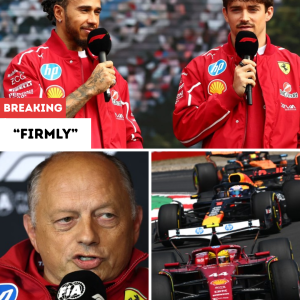
Scuderia Ferrari didn’t top every timing sheet in Bahrain.
They didn’t chase flashy headlines.
But inside the paddock, something far more unsettling was unfolding.
While cameras fixated on lap times, engineers from Red Bull Racing and Mercedes-AMG Petronas Formula One Team were staring at something else entirely — the rear of the mysterious SF26.
And what they saw made them uneasy.
A Tiny Detail With Massive Consequences


At first glance, it looked insignificant — a small aerodynamic element positioned near the exhaust.
But whispers spread quickly:
This wasn’t a bolt-on trick.
It was structural.
The entire rear architecture of the SF26 — gearbox layout, suspension geometry, packaging — had reportedly been designed around this concept from day one. Copying it wouldn’t mean adding a part.
It would mean redesigning an entire car.
And under modern cost caps and development limits, that’s nearly impossible mid-season.
The Sacrifice That Changed Everything
To understand the SF26, you have to rewind one year.
In 2025, under Team Principal Frédéric Vasseur, Ferrari made a controversial call: halt development of the SF25 early.
Fans were furious.
Media called it surrender.
Results faded.
But there was a hidden reward.
Finishing lower in the Constructors’ standings granted Ferrari significantly more wind tunnel and CFD time under Formula 1’s sliding scale regulations. While rivals fought for short-term gains, Ferrari quietly invested in 2026.
It was a brutal trade:
Short-term pain for long-term dominance.
A Radical Technical Reset


For sixteen years, Ferrari ran a pull-rod front suspension. With the SF26, that era ended.
The team adopted a push-rod layout front and rear — freeing airflow beneath the chassis and dramatically improving floor efficiency.
In modern ground-effect Formula 1, the floor is everything.
Cleaner airflow means:
-
Greater downforce
-
Better braking stability
-
Reduced tire degradation
-
More consistent long-run pace
Testing observers described the car as:
Predictable.
Stable.
Composed at high speed.
In championship terms, that’s terrifying.
The Engine Gamble No One Else Took
Beneath the bodywork, Ferrari made an even bolder move.
While most teams retained aluminum cylinder heads, Ferrari reportedly pursued steel — partnering with AVL to handle higher combustion pressures under 2026’s sustainable fuel regulations.
Steel is heavier.
But stronger.
The result? The potential for higher combustion efficiency and more durable performance across race distances.
And here’s the key:
Power units are tightly homologated. Once frozen, gains are locked in.
If Ferrari found horsepower others didn’t, it may stay that way all season.
Smarter, Not Louder
Ferrari also opted for a smaller Honeywell turbocharger.
On paper, that sounds like sacrificing peak power.
In reality?
-
Faster spool-up
-
Reduced turbo lag
-
Better drivability
-
Less battery dependency
That’s how you win races — not just headlines.
The Telemetry That Changed the Mood


During long-run simulations in Bahrain, Ferrari’s driver pairing — Lewis Hamilton and Charles Leclerc — didn’t chase one-lap glory.
They ran race distances.
And the numbers were chilling.
Lap after lap, the SF26 delivered metronomic consistency.
No overheating.
No tire cliff.
No dramatic drop-off.
Veteran analysts know the truth:
Championships aren’t won on testing headlines.
They’re won on repeatable long-run pace.
Why Rivals Are Nervous
The most dangerous part of Ferrari’s masterplan isn’t one component.
It’s integration.
The suspension feeds the floor.
The floor feeds the rear aero concept.
The engine supports efficiency.
The turbo improves drivability.
This isn’t an upgrade.
It’s a philosophy.
And that’s far harder to catch.
The Shadow of History
For years, Ferrari has promised resurgence.
But this feels different.
This doesn’t feel like speed.
It feels structural.
If Bahrain’s early signals are genuine, the 2026 championship fight may already have shifted — before a single race has been run.
For the first time in decades, Ferrari may not just be competitive.
They may be uncatchable.
And Formula 1 is about to find out.