In the scorching, furnace-like heat of pre-season testing in Bahrain, where political squabbles and whispered engine conspiracies usually dominate the paddock chatter, a single, unassuming piece of carbon fiber has ignited Formula 1’s first true firestorm of the 2026 season. It is not a revolutionary new power unit. It is not a secret battery deployment system, nor is it a controversial compression ratio loophole hidden deep within the internal combustion engine.
It is a rear wing. But to call it just a rear wing is a massive understatement. When the covers finally came off the breathtaking Ferrari SF26, camera lenses zoomed in almost instinctively, capturing a piece of aerodynamic engineering that sent immediate shockwaves down the pit lane. The upper rear wing element did something no wing had ever done before in the modern, highly regulated era of Formula 1: it rotated into what appeared to be a near 180-degree inversion.
In its low-drag, straight-line mode, the wing flipped so aggressively that the sponsor logos were literally turned upside down. The profile looked fundamentally broken. It looked impossible. To the untrained eye, and even to many seasoned veterans, it looked blatantly illegal. When legendary broadcaster and former driver Martin Brundle dismissed the radical design on air as little more than a theatrical “gimmick,” the rest of the paddock murmured in comfortable agreement.
It was easier to believe that Ferrari had built a showpiece rather than a game-changer. But in the ruthless, data-driven world of modern motorsport, telemetry does not lie, and the data tells a remarkably different story. This is not a gimmick. It is not a cheap loophole, and it is certainly not a cheat. It is rapidly emerging as the defining technical masterstroke of the 2026 season, and quite possibly, the bedrock foundation beneath Lewis Hamilton’s highly anticipated championship charge.
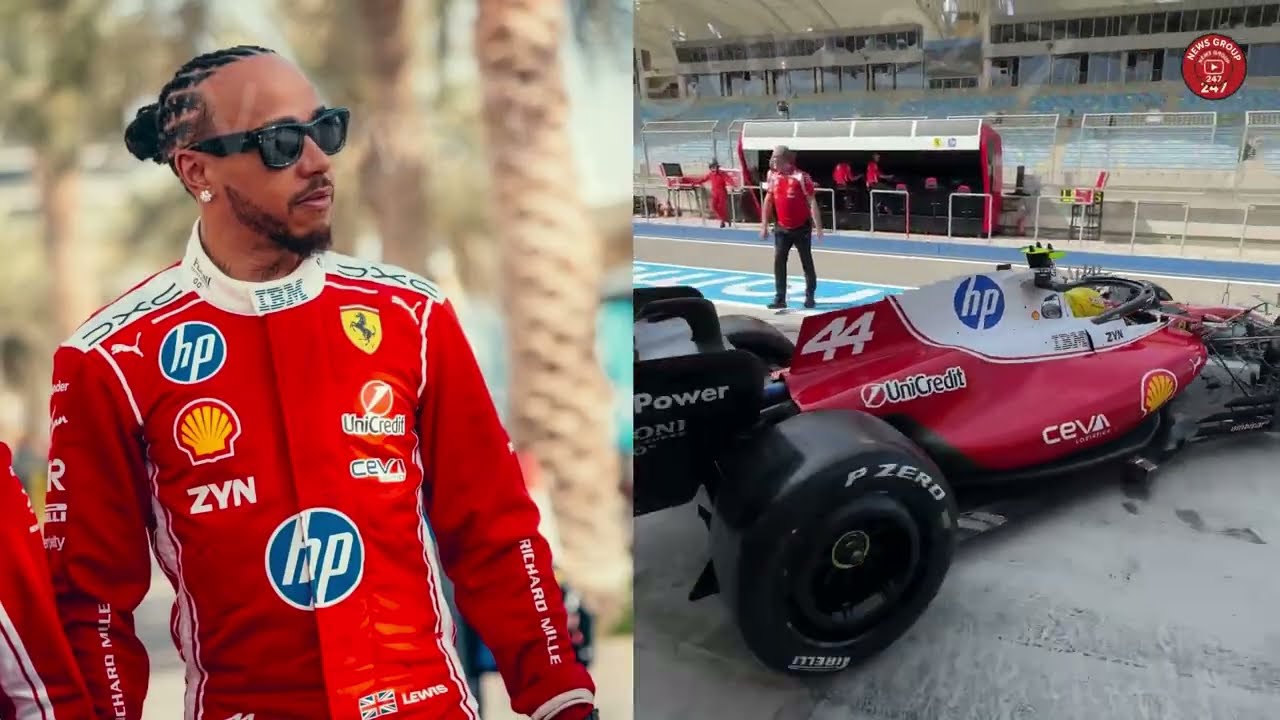
To truly understand the genius of the SF26, we must first look at why this wing shouldn’t logically exist. At first glance, Ferrari’s rotating 180-degree rear wing appears to violently defy basic aerodynamic common sense. Under the sweeping new 2026 regulations, traditional Drag Reduction Systems (DRS) were replaced by sophisticated active aerodynamics. This change allowed teams to legally switch their cars between high-downforce cornering configurations and sleek, low-drag straight-line modes. Faced with this new freedom, almost every team on the grid chose the path of predictable evolution over risky revolution. They designed conventional flaps that lift safely, reduce drag, and grant the car a predictable boost in top speed. It was the safe route. Ferrari, however, did the exact opposite.
In straight-line mode, the SF26’s upper element rotates dramatically rearward and downward, creating what visually registers as an inverted aerofoil. It looks profoundly unstable. It looks visually wrong, as if the immense, violent airflow should effortlessly tear the carbon fiber apart at 330 kilometers per hour. Yet, it holds beautifully. And that is precisely where the engineering genius of Maranello lies.
The controversy stems from the difference between static tests and dynamic reality. The FIA’s rigorous rear wing load tests are entirely static. Heavy hydraulic rams apply strictly defined forces to specific, targeted points of the wing assembly while the car is sitting completely stationary in the garage. Formula 1 engineers must ensure that any deflection remains within incredibly strict, millimeter-perfect tolerances. Ferrari passes every single one of these static tests comfortably. Naturally, critics and rival team principals immediately began suggesting trickery. Whispers of hidden hinges, illegal mechanical flexing, and a disguised, dark-arts return of the infamous “flexi-wings” echoed through the paddock.

But the SF26 is executing something far more sophisticated than crude bending. It utilizes highly controlled aero-elastic deformation. Ferrari’s bespoke carbon weave structure is not merely strong; it has been painstakingly engineered at a molecular level to behave differently under distinct, dynamic airflow conditions. In static tests, without the immense aerodynamic load distribution rushing across the full surface, the wing behaves rigidly and stays perfectly within legal parameters. However, under dynamic airflow at terminal racing speeds, massive pressure gradients act across the entire surface. This induces precisely calibrated micro-deformations. This is not visible, rule-breaking bending. It is engineered, intelligent elasticity.
The result is staggering. In straight-line mode, the inverted upper element generates localized lift that actively and purposefully cancels out the turbulent wake emanating from the main plane below it. Advanced paddock simulations now indicate a measurable, significant reduction in overall drag that is potentially far superior to the traditional flap-lift solutions utilized by Mercedes, Red Bull, and McLaren. Ferrari is not bypassing the rulebook; they are exploiting the raw laws of physics in a way that the current static testing rules simply cannot easily measure or penalize.
Yet, Ferrari’s aerodynamic brilliance does not stop at the end of the straight. The true magic happens in the braking zones. When the drivers slam on the brakes and the wing rapidly snaps back to its high-downforce mode, the aggressive rotation creates a momentary, violent surge in frontal surface area. Internally at Maranello, engineers affectionately describe this phenomenon as a “micro-parachute.” For a few crucial milliseconds, the car experiences a massive spike in drag that actively aids deceleration. But the benefits cascade further. Brake temperatures magically stabilize. The rear end of the car becomes incredibly planted and stable on corner entry. Over the grueling distance of a full Grand Prix, this directly translates to significantly decreased tire degradation. These marginal gains compound lap after lap, turning a fast car into an unstoppable race-day weapon.

This brings us to the most terrifying variable for the rest of the grid: Lewis Hamilton. The seven-time World Champion’s 2025 campaign was openly described by the man himself as one of his most difficult seasons. Transitioning to a new team is never a seamless endeavor, and Ferrari’s strategic, calculated pivot toward maximizing 2026 development left Hamilton navigating an awkward, evolving project. But now, the great reset has finally arrived. We have new engines, radically new aero philosophies, and entirely new energy deployment parameters.
Throughout his legendary career, Hamilton has built an unrivaled reputation for mastering transitional eras. He conquered the shift from V8s to hybrids, and from high-downforce monsters to the heavy ground-effect machines. The SF26 design philosophy plays flawlessly into his greatest, most unique adaptability. Hamilton is globally renowned for his surgical precision in the braking phases and his supernatural ability to manage tire life. Now, he has been handed machinery specifically engineered to amplify those exact strengths. The wing is not just aerodynamic theater; it is a bespoke instrument that perfectly complements his driving style. That alignment is absolutely no accident. If Ferrari’s aero-elastic wing provides even two-tenths of a second per lap in optimized conditions, that represents several grid positions in qualifying and a decisive, unstoppable overtaking capability in race trim. In modern Formula 1, world championships are often won by margins much smaller than that.
The uncomfortable, chilling truth for Ferrari’s bitter competitors is that replicating this masterpiece is virtually impossible in the short term. The 2026 cars were designed around tightly integrated, highly complex gearbox and rear suspension packaging. Ferrari’s rotating mechanism, actuator positioning, and specific carbon layup orientation were deeply built into the core architecture of the SF26 from the very first concept stage on the drawing board. Rival teams cannot simply bolt on a similar solution mid-season. Their structural geometry and load paths are already strictly homologated. By the time the competition can fundamentally redesign their rear ends to respond—if they even can—Ferrari and Hamilton may have already extracted an insurmountable half-season advantage.
Martin Brundle’s initial miscalculation is understandable. When he suggested the wing was a gimmick, he merely vocalized what many in the stunned paddock instinctively felt. It looked excessive. It looked like it was designed purely for dramatic headlines. But as the test days rolled on, the speed traps painted a horrifying picture for the rest of the grid. The SF26 demonstrated lethal straight-line efficiency without sacrificing a single ounce of corner entry stability. The long-run tire degradation was remarkably consistent. This wing is the crown jewel of a broader, ruthless aerodynamic philosophy designed to maximize adaptability under the most radical regulation reset in the sport’s history. Brundle, a man of great racing intellect, will undoubtedly revise his assessment the moment the lights go out in Melbourne.
The optics of the wing remain highly dramatic. Television cameras will continue to linger on its inverted profile, almost waiting for FIA officials to storm the red garage and strip the car of its legality. But every static inspection has been passed. Every load test has been entirely satisfied. The FIA has raised absolutely no formal protest. Ferrari did not bend the rules; they bent the carbon fiber precisely, predictably, and legally. In doing so, they have masterfully exposed a massive blind spot in how aerodynamic compliance is evaluated in this new era of dynamic systems.
For Lewis Hamilton, this season is about far more than just aerodynamics; it is about absolute legacy. An eighth World Championship would elevate him to a standalone pedestal in the rich history of global sports. Achieving that unprecedented milestone while dressed in the iconic scarlet red, carrying the crushing weight of expectation that surrounds Ferrari, would completely redefine his already mythological career narrative. If that historic campaign is ultimately powered by a strange, upside-down wing that critics once loudly laughed at, the victory will taste impossibly sweet. The SF26’s rotating marvel is engineering clarity at the bleeding edge of regulation. The rest of the Formula 1 grid has been officially warned.