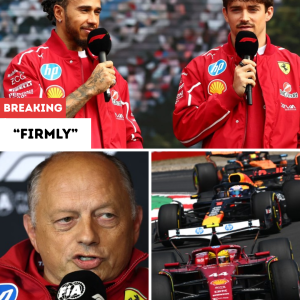
The first qualifying session of a new Formula 1 era is usually the moment when the truth finally emerges.
After months of testing, hidden performance, and strategic sandbagging, the stopwatch reveals the real competitive order.
But when qualifying ended at the 2026 Australian Grand Prix at Albert Park Circuit, the picture was anything but clear.
For Scuderia Ferrari fans, the headline looked worrying:
Lewis Hamilton – P7 on the grid, almost a full second behind George Russell and his pole-position Mercedes-AMG Petronas Formula One Team.
But that number hides a deeper story—one of strategy, tire management, and a Ferrari that may be far faster than the results suggest.
From Front-Row Pace to Qualifying Chaos
Just hours before qualifying, Hamilton looked like a genuine contender for the front row.
During the final practice session, the seven-time champion was the second fastest driver on track, running close to Russell’s Mercedes and ahead of most of the field.
Throughout the practice sessions, Ferrari’s pace was undeniable.
Hamilton consistently ran near the top of the timing screens, often separated from Russell by mere thousandths of a second. Meanwhile, his teammate Charles Leclerc also looked comfortable in the new SF26, giving the team confidence heading into qualifying.
Everything suggested Ferrari would be fighting near the front.
Then the strategy gamble arrived.
Ferrari’s Risky Tire Strategy
When Q1 began, Ferrari made a bold call.
While most teams sent their drivers out on the grippiest C5 soft tires, Ferrari opted for the harder C4 medium compound.
The idea was simple but ambitious:
Survive Q1 on mediums → save extra soft tires → attack in Q3.
In theory, it was a championship-level strategy.
And for a brief moment, it worked.
Hamilton even set a lap on medium tires that was temporarily faster than some drivers on softs, proving just how quick the Ferrari could be.
But in Formula 1, margins are microscopic.
As the track improved and rivals found more grip, Ferrari’s gamble quickly became dangerous.
The Tire Deficit That Changed Everything
Both Ferraris suddenly drifted toward the elimination zone.
Hamilton only barely escaped Q1 in sixth place.
But the real damage had already been done.
Because of the medium-tire gamble, Hamilton entered Q2 without fresh tires available—a massive disadvantage in modern Formula 1.
While rivals bolted on brand-new softs, Hamilton had to fight on used rubber.
The result was chaos.
At one point in Q2, Hamilton dropped to 16th on the timing screens, dangerously close to elimination.
He eventually fought back into the top ten, but by the time Q3 arrived, his tire allocation was completely compromised.
A Compromised Final Run
By the final segment, Hamilton’s qualifying rhythm had been shattered.
To make matters worse, Ferrari instructed him to yield track position to Leclerc during the session—further disrupting his final flying lap.
The result:
P7 on the grid
0.9 seconds off pole
On paper, it looked like Ferrari had fallen behind.
But that interpretation may be completely wrong.
Hamilton’s Surprising Reaction
After qualifying, Hamilton didn’t sound frustrated.
Instead, he sounded confident.
Speaking to reporters, he insisted the Ferrari was “much better than the result suggests.”
Based on his practice pace relative to Russell, Hamilton believed Ferrari could realistically have qualified inside the top three.
In other words, the car’s performance wasn’t the problem.
Strategy was.
Ferrari’s Hidden Race Pace
Data from Friday’s long-run simulations offers even more encouragement for Ferrari supporters.
While Mercedes appears to have the fastest car overall, Ferrari’s race pace on hard tires looked extremely strong.
Across multiple simulations, the SF26 consistently posted lap times faster than:
• McLaren
• Red Bull Racing’s rookie Isack Hadjar
That suggests Ferrari could be the second-fastest team on race pace, especially over longer stints.
Verstappen’s Shock Exit Changes the Race
Another major twist reshaped the grid.
During Q1, reigning champion Max Verstappen suffered a dramatic rear-axle lock-up entering Turn 1, sending his Red Bull into the barriers.
The crash eliminated him early and forced him to start near the back of the grid.
With one of the sport’s biggest threats out of position, the race suddenly opened up.
And that could play directly into Hamilton’s hands.
Why P7 Might Be the Perfect Launch Pad
The new 2026 regulations were designed specifically to allow closer racing and easier overtaking.
If the theory works in practice, Hamilton’s superior race pace could allow him to move forward quickly through the field.
Starting seventh might actually provide an opportunity rather than a limitation.
Especially with Verstappen out of contention at the front.
A Reborn Hamilton at Ferrari
Perhaps the most fascinating story of the weekend isn’t the strategy gamble—it’s Hamilton himself.
Observers have noticed a dramatic change in the driver since he joined Ferrari.
After years of frustration during the final stages of his Mercedes career, Hamilton now appears rejuvenated.
Confident.
Motivated.
Hungry again.
Experts watching trackside say both Hamilton and Leclerc look completely comfortable “hustling” the SF26 to its limits.
That confidence could be Ferrari’s biggest weapon this season.
The Bigger Picture
Viewed in isolation, P7 looks disappointing.
But in context, it may be little more than a strategic misstep in an otherwise promising weekend.
Ferrari gambled on tire strategy hoping to dominate qualifying.
Instead, they sacrificed the battle to protect resources for the war.
If the race-pace data proves accurate, the Melbourne grid position could become just a footnote in a much bigger story.
Because if Ferrari’s pace is real…
P7 might end up being the lowest point of Lewis Hamilton’s 2026 season.