In the high-stakes, adrenaline-fueled world of Formula 1, there is rarely a moment of genuine silence. Even when the roaring engines are momentarily shut off, the political maneuvering, strategic mind games, and relentless engineering battles continue behind closed doors.
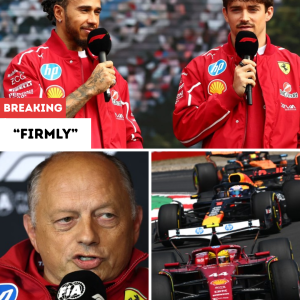
But recently, Ferrari team principal Fred Vasseur shattered that silence, dropping an absolute bombshell that has sent shockwaves rippling straight through the paddock and into the headquarters of their fiercest rivals.
According to Vasseur, the 2026 season is about to hit a hard reset. In his words, a completely new championship is going to begin at the upcoming Miami Grand Prix in May.
This is far from just empty talk or the typical pre-race psychological warfare. Vasseur is making this incredibly bold claim because the sport is currently colliding with two massive, game-changing developments at the exact same time. First, there is a brand-new, highly controversial FIA regulation that threatens to shatter the iron-grip dominance of the Mercedes engine. Second, Ferrari is aggressively rushing to complete an absolutely massive, factory-overhauling upgrade package during an unprecedented and unexpected break in the racing calendar. Together, these two factors could entirely rewrite the narrative of the current Formula 1 season.
Let us begin with the biggest talking point right now: the newly implemented ADUO program. Standing for “Additional Development and Upgrade Opportunities,” this revolutionary framework was constructed by the FIA with a clear, fundamental mission—to help teams burdened with slower, less efficient engines catch up to the runaway leaders. The overarching plan was always to measure raw engine performance over the course of the first few races of the season. If an engine supplier falls below a strictly defined speed threshold, the FIA grants them extra wind tunnel time, financial resources, and critical development allowances to upgrade their power unit.
With the Miami Grand Prix originally slotted as round six of the championship, it serves as the perfect evaluation point to activate this equalizer. At present, Mercedes undoubtedly boasts the most terrifyingly powerful engine on the starting grid, propelling George Russell and rookie sensation Kimi Antonelli to formidable leads. Ferrari’s power unit is certainly close, but the stark reality is that the Prancing Horse is bleeding crucial milliseconds on the long, high-speed straights. Because Ferrari officially carries this slight power deficit, they are directly in line to be the biggest beneficiaries of the new ADUO system. This incredible twist of fate means Ferrari is set to receive an FIA-sanctioned engine development boost just days before they arrive in Florida. They will finally have the permitted resources to close that agonizing straight-line speed gap. But they aren’t the only ones; Red Bull and Audi, who have struggled with even slower engines, will also receive a lifeline. The ADUO program is a massive, unpredictable wild card that could completely scramble the running order, turning the midfield into a battlefield and dethroning the leaders.
However, Ferrari is not a team built on waiting for handouts from the governing body. They are seizing their own destiny by unleashing a radical aerodynamic overhaul. The sudden, unforeseen cancellation of the races in Bahrain and Saudi Arabia created a bizarre, five-week void in the calendar. Instead of spending millions flying freight around the globe, teams have been locked inside their respective headquarters. This extended hiatus has sparked an absolute gold rush for car development. Inside the historic gates of Maranello, Ferrari is pushing the boundaries of engineering harder than anyone else on the grid.
Vasseur has confidently confirmed that Ferrari is bringing what he playfully but ominously calls a “package and a half” to the streets of Miami. Originally, the team’s development roadmap dictated a series of smaller, incremental updates to be introduced during the Middle Eastern leg of the tour. But when those races were abruptly removed, Ferrari’s strategists tore up the playbook. They boldly combined all those planned micro-updates into one giant, aggressive upgrade package.
The crown jewel of this new setup is a completely redesigned floor. In the modern era of ground-effect Formula 1 aerodynamics, the floor is arguably the most vital organ of the car. It acts as an invisible hand, generating the massive vacuum of grip that aggressively sucks the car down into the asphalt. Ferrari’s engineering team hopes this newly sculpted floor will dramatically increase downforce while simultaneously shedding drag—the suffocating air resistance that robs cars of their top speed. If the new floor performs as the wind tunnel data suggests, Ferrari will be able to run significantly smaller, flatter rear wings. A smaller wing equates to a ferocious top speed, directly curing their straight-line deficit without sacrificing the awe-inspiring cornering grip that both Lewis Hamilton and Charles Leclerc have praised all season. If they can marry high-speed straight-line dominance with their current cornering magic, the Ferrari could genuinely become an unstoppable force.
Yet, the floor is only one piece of the puzzle. The true ace up Ferrari’s sleeve is a highly experimental, heavily whispered-about component that paddock insiders have dubbed the “Macarena Wing.” This revolutionary rear wing is designed to physically move, flex, and twist when the driver activates the DRS (Drag Reduction System) flap on a straightaway. Simulated computer tests have produced jaw-dropping numbers, indicating that this dancing wing could make the scarlet cars a massive three-tenths of a second faster on high-speed circuits. Ferrari actually strapped an early prototype of the Macarena Wing onto the car during a practice session in China, but it was abruptly removed after causing severe rear-end instability during heavy, high-speed braking. Now, engineers in Italy are pulling sleepless nights to iron out those terrifying aerodynamic kinks, desperate to make the wing lighter, stiffer under braking, and safer to deploy in the heat of battle.
To guarantee that this mountain of new carbon fiber actually translates to real-world lap time, Ferrari has quietly orchestrated a secret shakedown. They have booked the legendary Autodromo Nazionale Monza for a private test on April 22nd. Under the guise of a 200-kilometer “filming day,” both Hamilton and Leclerc will get behind the wheel. Monza’s endless straights provide the ultimate laboratory to validate top speeds and ensure the Macarena Wing behaves before crating the million-dollar parts up and shipping them to the United States.
It is this rigorous, aggressive testing that gives Fred Vasseur his quiet, smiling confidence. But Ferrari is far from the only predator sharpening its teeth in the dark. Every single team is treating this bizarre five-week gap as a second winter testing period. Over at Woking, McLaren is finalizing a colossal upgrade of their own. Whispers from the McLaren simulator suggest spectacularly fast numbers, and with Oscar Piastri already proving the car’s raw pace by nearly snatching a victory in Japan, a successful Miami upgrade could see the Papaya cars leapfrogging Ferrari entirely. The battle for the mantle of ‘best of the rest’—and the chance to hunt down Mercedes—is shaping up to be an absolute bloodbath.
For the reigning champions at Mercedes, the pressure is mounting to a boiling point. The Silver Arrows enjoyed a relatively comfortable cruise through the first three rounds of the year, but they are acutely aware that the wolves are at the door. Mercedes cannot afford to rest on their laurels; they must bring their own counter-upgrades to Florida to defend their throne. The race to build the fastest machine has evolved into an all-out, no-holds-barred development war, and whoever wins the arms race this spring will likely dictate the entire narrative of the 2026 season.
The Miami Grand Prix is no longer just a glamorous event adorned with celebrities and fake marinas; it has transformed into the ultimate crucible of the year. If Ferrari’s monumental gamble pays off, fans will finally be treated to the titanic, generation-defining championship battle they have been begging for. Lewis Hamilton, desperate to validate his shocking move to Maranello, will finally have the weapon he needs to hunt down an unprecedented eighth World Championship. On the other side of the garage, Charles Leclerc will drive with the primal hunger of a man out to prove he is the undisputed king of Ferrari. Both men will push the car to its absolute, ragged edge.
However, the stakes are equally terrifying. If Ferrari’s upgrades fail to correlate with the simulator—if the Macarena Wing stalls, or the new floor creates unpredictable bouncing—their season could be irrevocably destroyed. A failed major upgrade crushes team morale and wastes weeks of budget cap resources trying to fix inherent flaws, while Mercedes and McLaren disappear into the distance. Fred Vasseur has bravely painted a target on his own back by publicly promising a new era in Miami. If they arrive and are still staring at the rear wing of a Mercedes, the notoriously ruthless Italian media will demand immediate answers.
The wind tunnels are howling, the simulators are glowing into the early hours of the morning, and the engineers are running on fumes and espresso. When the grid lines up under the blazing Florida sun, the cars will look, sound, and race differently. The warm-up is officially over. The real Formula 1 championship is about to begin.