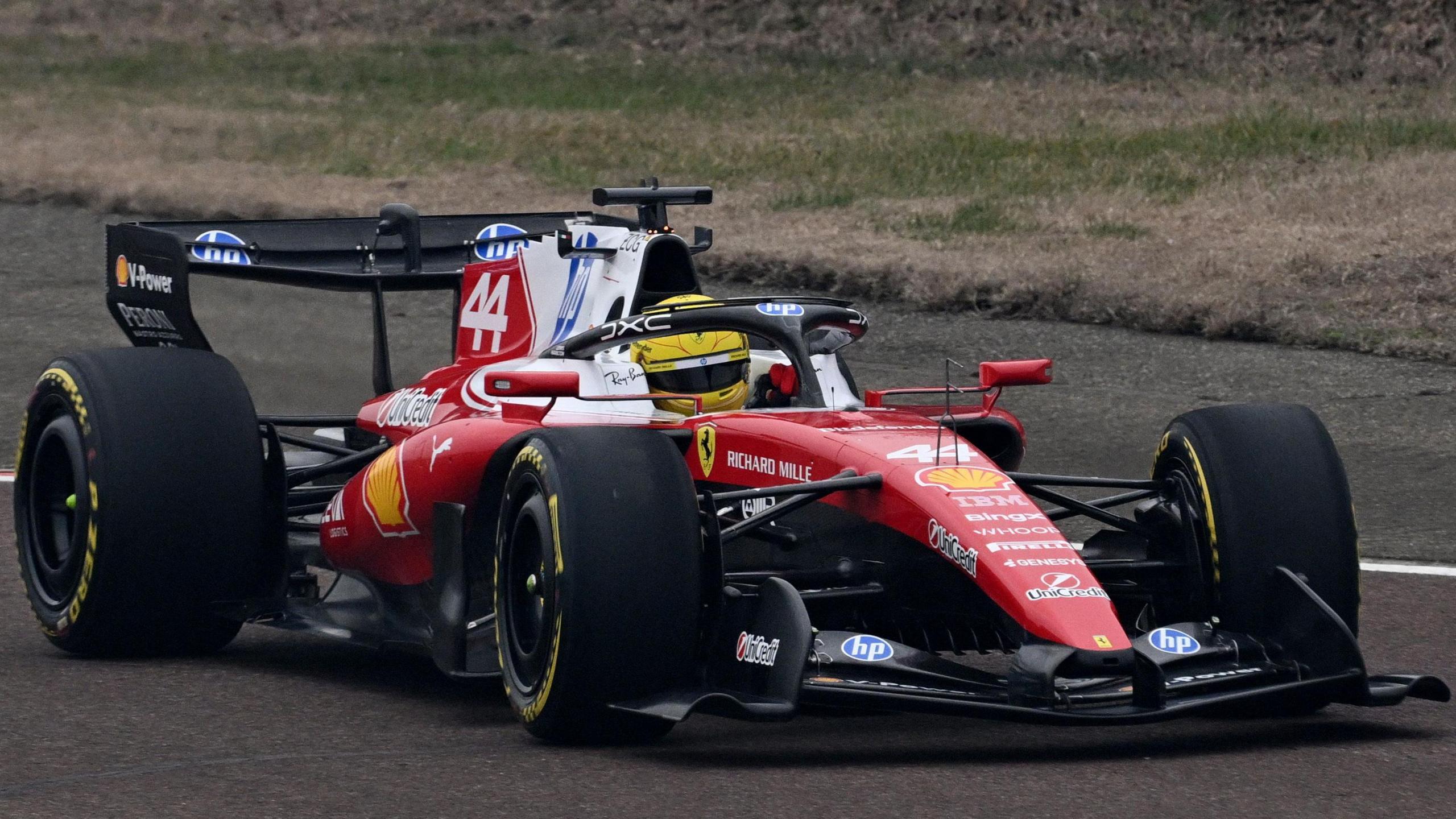
The silence in the paddock was deafening. It wasn’t the absence of noise that caught everyone’s attention; it was the absence of panic. On Day One of the 2026 pre-season testing in Barcelona, the Ferrari SF26 rolled out of the garage, and for the first time in years, it didn’t look like a desperate prototype held together by hope and duct tape. It looked like a finished product. It looked like a championship winner.
While the rest of the world obsessed over the superficial drama of Twitter feeds and raw lap times, the Scuderia was busy executing a masterclass in deception and engineering perfection. The narrative circulating on social media was predictable: “Same old Ferrari,” they typed, pointing to the timing screens where Max Verstappen sat comfortably ahead. But those screens were lying. And if you looked past the numbers, deep into the data where the championships are actually won, a different, more terrifying story for Ferrari’s rivals began to emerge.

The “Slow” Lap Time Myth: A Masterclass in Sandbagging
Let’s address the elephant in the room immediately. Charles Leclerc posted a 1 minute and 20.88 seconds lap time. Max Verstappen, in the Red Bull, clocked a flat 1 minute and 20 seconds. On paper, that is a lifetime in Formula 1—nearly nine-tenths of a second slower. For the casual observer, it was proof that Red Bull was untouchable.
But Formula 1 is not raced on paper. It is raced on physics and fuel loads.
Analysis of the SF26’s ride height, sparking patterns, and floor behavior revealed that Ferrari was likely running with a massive fuel load—estimated at roughly 70 kilograms. In contrast, Red Bull appeared to be in “qualifying trim,” running light on fuel to chase headlines and sponsor-pleasing glory runs. In the world of F1 physics, weight is the enemy of speed. Every 10 kilograms of fuel costs a car approximately three-tenths of a second per lap.
Do the math. If you correct for the fuel disparity, Ferrari wasn’t slower. They were potentially faster.
But the speed wasn’t the scariest part. It was the consistency. Leclerc wasn’t wrestling the car. He was reeling off lap after lap within a tenth of a second of each other. That kind of consistency doesn’t come from luck; it comes from a car with a “sweet spot” so wide that track temperature changes and tire degradation barely register. Ferrari wasn’t chasing a lap time; they were simulating a race win.
The Engine Revolution: Solving the 50/50 Puzzle
The 2026 regulations are the biggest technical shake-up in a generation, demanding a 50/50 split between internal combustion power and electric power. This sounds simple in a press release but is a nightmare for engineers. The biggest fear for every team is “clipping”—that dreaded moment at the end of a straight when the battery runs dry, and the car suddenly loses 500 kilowatts of power, leaving the driver a sitting duck.
Most teams in Barcelona were struggling to make their systems talk to each other. You could hear it on the onboard cameras—engines cutting, harvesting aggressively, power deliveries stuttering.
The Ferrari SF26 never clipped. Not once.
Even at full throttle down the long main straight of the Circuit de Barcelona-Catalunya, the Ferrari power unit (codenamed 0671) was still pulling hard when rivals were hitting their electrical limits. This suggests Ferrari has cracked the code on energy deployment and recovery efficiency. While Mercedes was debugging software and Red Bull was chasing cooling limits, Ferrari was running full Grand Prix distances without a hiccup.
This is a testament to the “revolution” led by Team Principal Fred Vasseur. He didn’t come to Maranello to polish the old ways; he came to burn them down. The SF26 isn’t an evolution of the cars that “almost” won in 2022. It is a ground-up rethink of what a modern F1 car should be.
The Rain Test: Where Downforce Goes to Die
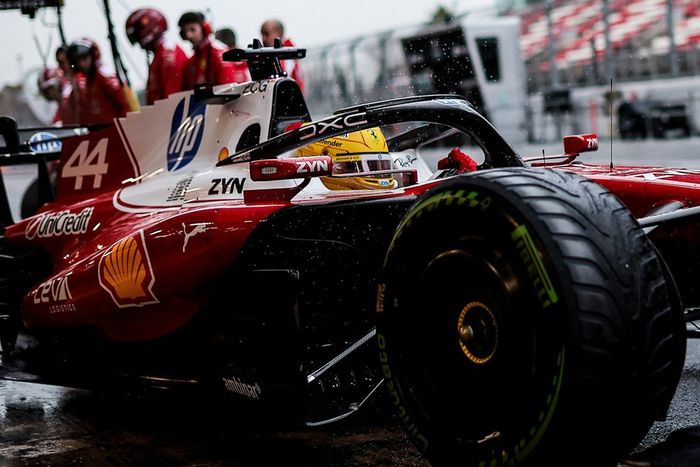
If the dry running was impressive, the wet weather performance was a revelation. When the skies opened up at 10:30 AM, the paddock essentially shut down. In testing, teams are terrified of damaging their new cars in the wet. Downforce disappears, and the data becomes noisy.
Most teams parked. Charles Leclerc went out.
What happened next was a display of mechanical grip that should keep Red Bull engineers awake at night. As the track transitioned from full wet to drying, Leclerc’s lap times didn’t jump erratically. They dropped in a perfectly linear progression, from 1:46s down to 1:30s.
This linearity proves that the SF26 has an incredibly stable center of pressure. The car doesn’t “snap” or bite the driver when grip levels change. It relies on mechanical grip—suspension, differential, and chassis balance—rather than just aerodynamic load. A car that is fast in the dry is good; a car that is predictable and fast in the wet is a title contender.
The Lewis Hamilton Factor
Then, there is the human element. The world has been waiting to see Lewis Hamilton in Ferrari red, and his first real session was a study in professionalism. He didn’t go out to set purple sectors. He spent his entire afternoon calibrating.
Hamilton is notorious for his sensitivity to how a car communicates through the steering wheel and brake pedals. He spent hours adjusting rotary positions, energy recovery paddles, and brake-by-wire feel. The fact that he completed his full program in damp, tricky conditions without a single lock-up or spin tells us everything we need to know about the car’s interface.
The SF26 is intuitive. A seven-time World Champion trusted it immediately.
Crucially, both Hamilton and Leclerc reported the exact same characteristic: incredible traction on corner exit. In 2026, with 500kW of instant electric torque trying to shred the rear tires, the team that can put power down without wheelspin will dominate race pace. Ferrari’s rear suspension seems to be managing that electric punch better than anyone else. While the Red Bull looked nervous and twitchy on throttle application, the Ferrari looked planted.
The Verdict: A Dynasty in Danger?
By the end of the test, Ferrari had completed 196 laps across the SF26 and the Haas customer car (driven by Esteban Ocon, who was feeding intel back to Maranello). That is nearly three Grand Prix distances of data while others were barely managing one.
This wasn’t just a test session; it was a message.
To Red Bull: Your era of easy dominance is ending. To Mercedes: We took your greatest weapon (Hamilton), and he is ours now. To the Tifosi: The waiting might finally be over.
Of course, testing is notorious for false dawns. We have seen Ferrari win the “winter championship” before, only to crumble when the lights go out in Bahrain. There are three scenarios left. One: Ferrari’s reliability holds, and the Hamilton-Leclerc pairing becomes the most lethal force on the grid. Two: The cracks appear under race pressure, and thermal management becomes an issue. Three: The rivals catch up.
But only one truth matters right now. The SF26 is a machine built by a team that stopped looking over its shoulder at Red Bull and started writing its own story. The 0.8-second gap on the timing screens is a smokescreen. The real story is the silence of a car that works perfectly, the confidence of a team that knows something we don’t, and the looming realization that Ferrari might have already won the engineering war of 2026.
If you thought the Red Bull dynasty was invincible, think again. The Prancing Horse isn’t just back; it’s leading the stampede.