The air is crisp, the Tifosi are already lined up at Turn One screaming as if the championship is being decided today, and a white cockpit carrying a red dream rolls onto the asphalt. Lewis Hamilton has officially climbed into a Ferrari.
It is a moment that transcends sport—a visual that history books have waited years to print. But as the seven-time world champion took the SF-26 for its first shakedown, the real story wasn’t the driver. It was the machine underneath him, a car that represents the single biggest technical gamble Ferrari has taken in sixteen years.
This wasn’t just a ceremonial lap; it was the unveiling of a philosophy so aggressive it borders on madness. While the world watched the livery, the technical paddock was buzzing about what couldn’t be seen. Ferrari hasn’t just adapted to the sweeping 2026 regulation changes; they have reached back into the past and potentially unlocked a future that no one else saw coming.

The “Steel” Rumor That Has the Paddock Shaking
The most explosive talking point surrounding the SF-26 is hidden deep within its power unit. We are entering a new era of Formula 1 where the MGU-H is gone, and the power split is nearly 50/50 between the internal combustion engine (ICE) and the electric motor. Everyone is starting from zero. But Ferrari is reportedly hiding something radical: a steel alloy cylinder head.
For decades, aluminum has been the standard—lightweight and efficient. But sources from the Italian motorsport media and whispers in the paddock suggest Ferrari has partnered with Austrian specialists to develop a steel alloy component incorporating copper and ceramic composites.
Why steel? In the new 2026 era, the internal combustion engine needs to handle unprecedented pressures to squeeze out every kilowatt of its 400kW allowance. Aluminum melts or deforms under the extreme heat and pressure Ferrari is targeting; steel does not. Previously, the weight penalty would have made this impossible. However, the new regulations have raised the minimum power unit weight from 120kg to 150kg. This 30kg buffer has given Ferrari’s engineers a window to introduce heavier, more durable materials without a penalty.
If this rumor is true—and Ferrari’s absolute silence suggests it might be—they could run their engine harder, hotter, and more aggressively than Mercedes or Red Bull, who may still be relying on traditional aluminum architectures. It’s a secret weapon that could grant them a fundamental horsepower advantage that rivals cannot copy overnight.
Reverting to the Past: The Suspension Gamble
While the engine looks to the future, the chassis has taken a shocking look at the past. The SF-26 is running a push-rod suspension configuration on both the front and rear. For the uninitiated, Ferrari hasn’t touched this setup since 2010—the days of the F10 and Fernando Alonso.
For the last 16 years, pull-rod suspension dominated because of ground-effect aerodynamics and Venturi tunnels. But the 2026 rules have erased those tunnels. The aerodynamic floor philosophy has changed completely. Ferrari realized that the pull-rod system, effective for the last era, was now obsolete. In a move of brutal efficiency, they ripped apart their suspension philosophy, redesigned the gearbox from scratch, and relocated the kinematics.
This is a massive risk. They are betting their entire season—and Hamilton’s debut year—on a mechanical system they haven’t raced in over a decade. If the data correlation is wrong, there is no quick fix. They would be starting the season with a fundamental handling flaw that could take months to correct.
Stealing from the Best
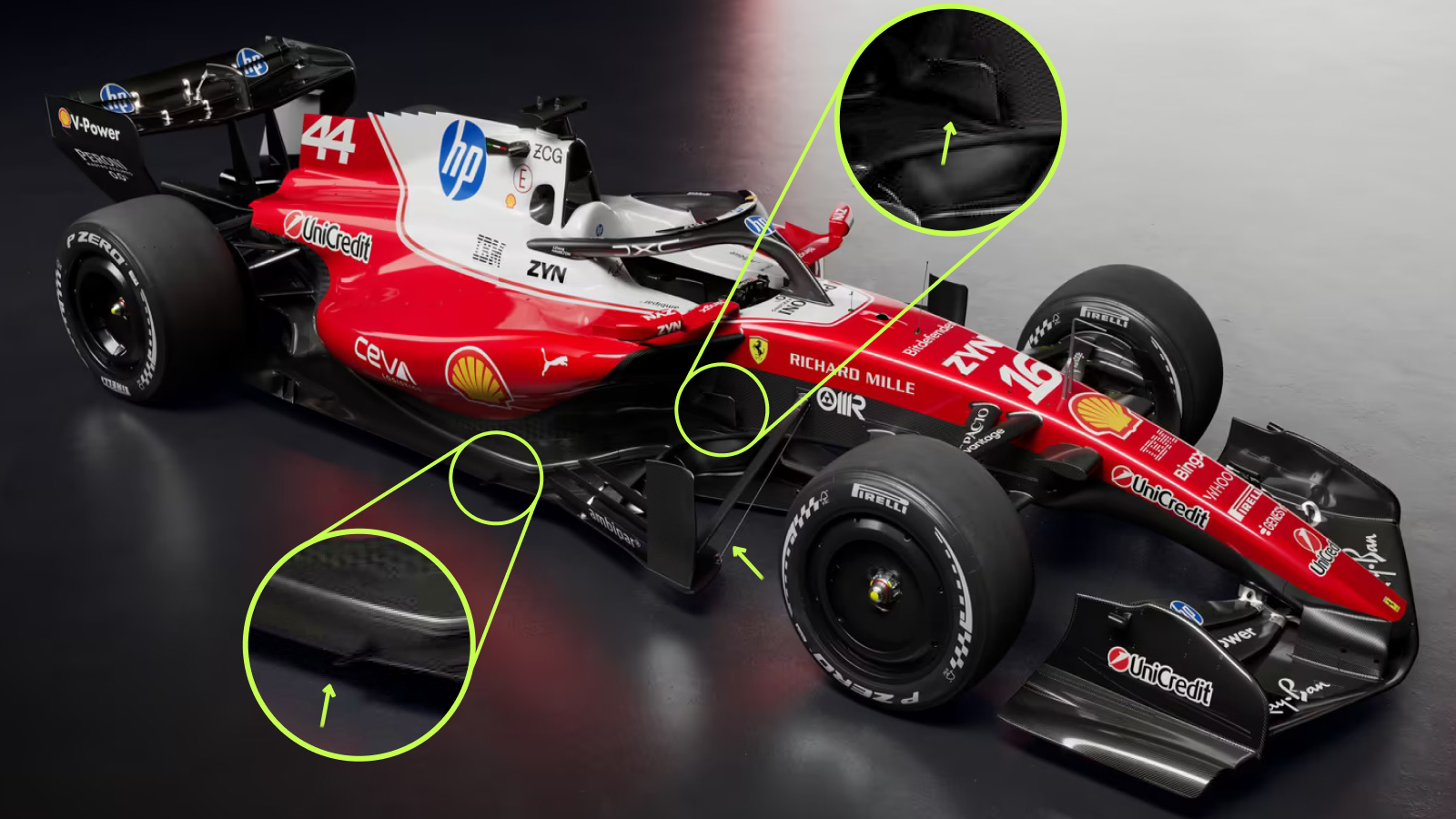
Ferrari is proud, but they are no longer stubborn. One of the most telling details of the SF-26 is its steering geometry. The team has adopted a design pioneered by McLaren and later copied by Mercedes, moving the track rod arms behind the lower wishbone to clean up airflow to the floor.
This signals a new maturity in Maranello. They aren’t trying to reinvent the wheel just for the sake of being different. They are synthesizing winning concepts from across the grid—McLaren’s steering, Mercedes’ brake ducts—and fusing them with their own radical engine and suspension ideas. It is a Frankenstein monster of best-in-class engineering, designed with one singular goal: winning.
The Weight of Silence
Perhaps the most concerning—or exciting—aspect of this launch is what Ferrari isn’t saying. Team Principal Fred Vasseur admitted the car was finished only 24 hours before the launch, calling the timeline “aggressive.” The car that ran at Fiorano is a “Spec A” baseline, built for reliability. The real aerodynamic evolutions won’t arrive until testing in Barcelona.
This creates a nerve-wracking dichotomy. On one hand, the “steel head” engine could be a masterstroke that hands Hamilton a car with superior power and reliability. On the other hand, if the concept is flawed, Ferrari has started development with a heavier engine in a year where weight reduction is critical. Every kilogram over the limit costs roughly three-tenths of a second per lap. If the steel concept fails to deliver the performance to justify its weight, the SF-26 will be a heavy, slow tractor.

Genius or Bluff?
The 2026 season is not just about who is the fastest; it is about who adapted best to a complete rewrite of the rulebook. Mercedes is known for conservative, bulletproof engineering. Red Bull is an aerodynamic powerhouse. Ferrari has chosen the path of high-risk innovation.
Lewis Hamilton did not leave Mercedes to drive a safe car. He went to Ferrari to chase a legend. If the steel cylinder head works, he could cruise to an eighth title while rivals scramble to understand Ferrari’s engine data. If it fails, his final years in the sport could be spent fighting a car that was too clever for its own good.
Ferrari didn’t build the SF-26 to finish second. They built it to dominate or to fail spectacularly. And as the engine fired up at Fiorano, sounding unlike anything else on the grid, one thing became clear: The Prancing Horse is no longer galloping; it is charging blindly into the unknown, dragging the rest of the Formula 1 world with it.
We will find out the truth in Barcelona. Until then, the “Steel Secret” remains the most dangerous unknown in motorsport.