Three hundred metres. In the grand scheme of a Formula 1 circuit, it is a fleeting distance, a mere blink of an eye for machines engineered to defy the laws of physics. Yet, it took precisely 300 metres of legendary Japanese asphalt at Suzuka to expose the most uncomfortable and glaring truth in the sport right now. Lewis Hamilton, a seven-time world champion and statistically the greatest driver in the history of Formula 1, is currently trapped inside a machine that is slowly dying beneath him.
To the casual observer watching the broadcast, the Japanese Grand Prix might have looked like a standard, albeit underwhelming, weekend for the British icon. The television cameras displayed a respectable, if uninspiring, P6 finish.
However, deep within the confines of the Maranello garage, the telemetry screens were telling a horror story of epic proportions. The pressing question that Ferrari top brass desperately wants to avoid answering is this: why did Lewis Hamilton look like an absolute sitting duck in a car that was fundamentally supposed to set him free? And, perhaps more crucially, can the upcoming updates in Miami save his championship campaign before it is irreversibly too late?

Suzuka is universally revered as a true driver’s circuit. It is a high-speed cathedral of motorsport, the kind of unrelenting, punishing environment where the true champions are decisively separated from the mere passengers. On paper, Hamilton did exactly what was asked of him. His tyre management was practically flawless. His restart following the safety car period was clinical. His positioning in the opening phases was absolutely textbook, elevating him to P3 with a podium trophy firmly in his sights. The redemption story was practically writing itself.
But then, the inexplicable began to unfold. The cars behind him—machines that were mathematically and aerodynamically supposed to be slower through the sweeping high-speed corners—began eating him alive on the main straights. They did not catch him gently or gradually; they swallowed him up with a vicious aggression. The race pace data is entirely devoid of emotion, and it simply does not lie. Charles Leclerc, sitting in the exact same chassis, operating out of the very same garage, was consistently lapping the circuit at 1 minute 34.4 seconds. Hamilton, shockingly, was logging a staggering 1 minute 36.2 seconds.
A 1.8-second gap between two theoretically identical cars is an anomaly that defies modern racing logic. In contemporary Formula 1, engineers and drivers argue bitterly over hundredths of a second. They occasionally bicker over tenths. They absolutely never, under any circumstances, find themselves debating whole seconds. Yet, the stopwatch confirmed the brutal reality.
This devastating delta was only the beginning of the nightmare. When Hamilton pressed his radio button to communicate with the pit wall, the tone of his voice carried an alarming weight. He was not asking for strategy tweaks, nor was he seeking a quick morale boost. He was demanding to know why his teammate had considerably more power. They shared the same car, the same engine designation, and the identical fuel load, yet they were operating in entirely different realities.

The telemetry ultimately confirmed what the Ferrari engineers were desperately, and somewhat frantically, attempting to explain away behind closed doors. At the exact same point on the track, precisely 300 metres before the heavy braking zone, Hamilton’s speed trace would completely flatline and then visibly violently dip. Meanwhile, the Mercedes W7 beside him was still screaming relentlessly toward the infamous 130R corner.
Engineers have a specific, chilling term for this terrifying phenomenon: the clipping zone. The MGUK—the highly complex electrical heart of the modern hybrid system—had run completely dry. Hamilton’s battery had dangerously overheated and, entirely exhausted of its energy reserves, forcibly triggered a 15 percent power cut to protect its internal components from a catastrophic failure. Hamilton was not losing crucial race positions because of a sudden decline in his unparalleled driving ability; he was tumbling down the order because his car was autonomously choosing basic survival over competitive speed.
Ferrari’s subsequent response has been immediate, highly clinical, and on the surface, somewhat reassuring. The Scuderia is preparing to unleash a brand-new engine iteration for the Miami Grand Prix. This package features fresh internals, completely recalibrated sensors, and a vastly improved cooling architecture. Under the strict 2026 reliability and safety loophole, teams can legally introduce a revised power unit if they can prove an existing flaw compromises the safety or fundamental operation of the car. By citing the mysterious, chronic power loss at Suzuka as their official justification, Ferrari has initiated a total reset.
Problem solved, one might assume. However, the grim reality of this 50/50 power-split era of Formula 1 is that mechanical hardware is only half the battle. The true issue causing chaos in the Ferrari camp was not simply what was bolted under the engine cover; it was the intense conversation happening over the airwaves.
Hamilton’s radio interactions at Suzuka were incredibly telling. He demanded exact, forensic breakdowns of his energy usage. He wanted to know, corner by corner, exactly how much battery he was burning in Turn Six compared to the demanding S-curves. That level of extreme, granular detail requires far more than a standard race engineer. It requires a specialist hybrid whisperer, and Ferrari explicitly knew it.
Enter Cedric Michelle Grojan. He is not just a new voice on the other end of Hamilton’s radio; he is effectively a human CPU, specifically designated to bridge the widening gap between a seven-time champion’s instinctual driving style and a fundamentally flawed energy delivery system. The detail that completely changes the dynamic of this championship is Grojan’s origins. He did not rise through the ranks within Ferrari’s historic walls. He was, for all intents and purposes, stolen directly from McLaren.
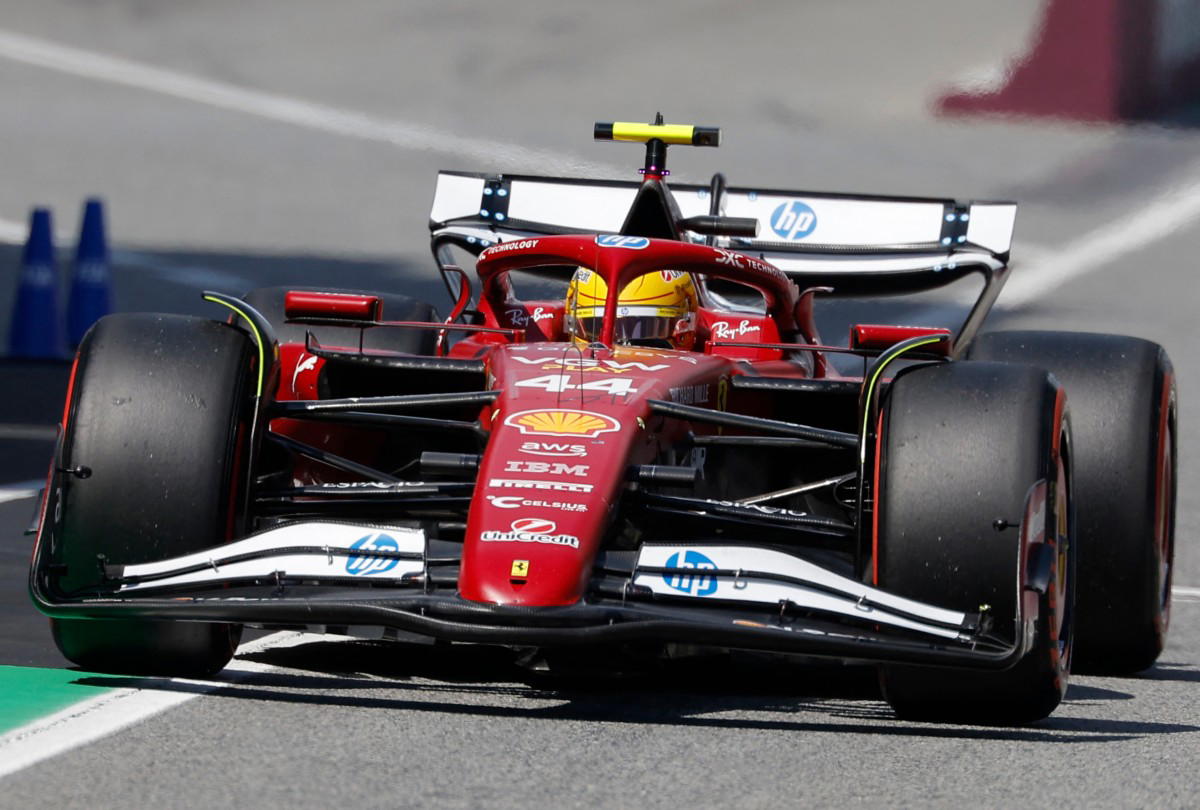
Having spent years working closely alongside Oscar Piastri at Woking, Grojan possesses something far more valuable than standard engineering acumen. He understands the foundational source code of the Mercedes power unit—the very engine that is currently humiliating Ferrari on a weekly basis. Ferrari has purposefully paired the greatest driver in Formula 1 history with an engineer who carries the institutional knowledge of the absolute benchmark engine they are desperately trying to dethrone. Grojan understands exactly how Mercedes effortlessly manages its duty cycles, how it entirely avoids the dreaded thermal derating wall, and how it intelligently meters energy across an entire lap rather than dumping all its reserves at the start of a straight and running dry 300 metres later.
The partial throttle data extracted from Suzuka served as the undeniable smoking gun for this entire crisis. Hamilton spent a concerning 27 percent of his fastest lap operating at partial throttle—the highest percentage of any front-running driver on the grid. He was forced to tiptoe through the highly technical sections of the circuit because the car’s rear end was simply too nervous and unpredictable to handle full torque deployment. In this era of Formula 1, when a driver cannot fully commit to the throttle pedal, the car physically cannot harvest kinetic energy. When the car cannot harvest energy, the battery goes completely bankrupt long before the finish line.
Grojan’s immediate, critical mission ahead of Miami is to completely recalibrate the torque fill maps. He must engineer the power delivery to feel significantly less like a violent light switch and much more like a progressive, trustworthy tool that Hamilton can actually lean on.
The consequences of the Suzuka breakdown extend far beyond a single, miserable points haul for Hamilton. On a personal level, it represents a deep crisis of confidence in the machinery provided to him. Here is a 41-year-old champion who routinely ran 100 kilometres through the streets of Tokyo during the break, definitively proving that his body and mind remain at the absolute peak of athletic readiness. Yet, he finds himself being held hostage by invisible electrons that he cannot physically control. Following the race, Hamilton bluntly stated that Ferrari is “miles and miles away.” That was not mere frustration talking to the media; that was a direct, technical ultimatum delivered squarely to the factory.
As a constructor, the reality for Ferrari is even more utterly brutal. The top speed data traps from Japan revealed a humiliating statistic: Nico Hulkenberg’s customer Haas Ferrari effortlessly topped the speed charts at a blistering 349 km/h. The Works team Ferrari, entirely remarkably, was 12 km/h slower. Their own customer car is outrunning them in a straight line because the factory team desperately needs to bolt on heavy downforce to cure their cornering woes, which in turn creates massive aerodynamic drag that they simply cannot overcome electrically. They are, quite literally, aerodynamically and electrically bankrupt the moment they reach the straights.
Looking at the broader championship picture, Mercedes has not merely built a faster car; they have built a significantly more usable car. They have engineered a machine where drivers do not have to constantly obsess over energy management; they simply get in and drive on pure instinct. Meanwhile, Hamilton is forced to manage his deployment like a man defusing a bomb—operating a highly temperamental system with absolutely zero margin for error. Ferrari is currently in genuine danger of slipping toward fourth in the technical pecking order, which, for a team with their prestige and budget, is the very definition of a full-blown crisis.
So, where does this monumental pressure cooker leave us as the paddock descends upon Miami? There are realistically three scenarios that could unfold under the Florida sun.
In the first scenario, the heavily updated engine finally delivers its promised thermal headroom. Cedric Michelle Grojan successfully unlocks the complex deployment maps, allowing Hamilton to rediscover his intrinsic confidence to attack the apexes. If this happens, Miami will be remembered as the exact moment the real 2026 championship campaign finally roared into life.
The second scenario is decidedly bleaker. The engine upgrade provides a minor boost, but the fundamental, inherent aerodynamic drag of the chassis remains entirely unsolved. The massive, downforce-heavy rear wing—finally deployed on Miami’s exceptionally long straights—proves entirely too unstable under chaotic race conditions. Hamilton crosses the line to finish yet another demoralising Sunday, profoundly wondering if the SF26 will ever truly bend to his will.
The third and most terrifying scenario for the Italian outfit is that Mercedes sits back, calmly watches Ferrari’s desperate scrambling unfold, and simply turns up their own engine modes. The most incredibly dangerous team in Formula 1 right now is not necessarily the one fighting the hardest to survive; it is the team that hasn’t even needed to show its true performance ceiling yet.
Can a brand-new engine iteration and a poached rival engineer truly erase a monumental 1.8-second internal performance gap in the space of a single race weekend? Or is the SF26’s thermodynamic and aerodynamic crisis rooted far deeper than any regulatory loophole fix can realistically solve?
One undeniable truth remains absolutely certain as the clock ticks down. Lewis Hamilton did not pack up his life and move to Maranello simply to manage damage limitation on a Sunday afternoon. He moved to the iconic Italian squad to win historic world championships and cement an untouchable legacy. The upcoming race in Miami is no longer just another glamorous stop on the bustling Formula 1 calendar; it is a definitive, uncompromising deadline.
This dramatic season has proven it is no longer just about who possesses the rawest speed on a Saturday qualifying session. It is fundamentally about who can successfully survive the vicious engineering politics and technical traps long enough to actually matter when the chequered flag falls on a Sunday. The entire motorsport world is now watching with bated breath to see if Miami will be the spectacular prison break Ferrari has boldly promised, or merely just another agonising lap trapped inside the exact same thermodynamic nightmare.
