In the high-stakes, hyper-competitive world of Formula 1, the margin between glorious victory and crushing defeat is often measured not in minutes or even seconds, but in microscopic fractions of a moment. In this realm of absolute precision, engineers spend millions of dollars to shave a single thousandth of a second off a lap time.
Every piece of carbon fiber is endlessly analyzed, every drop of fuel is calculated, and every driver is trained to operate at the absolute ragged edge of human capability. Yet, amidst all this technological warfare and immense pressure, one driver has consistently found a way to elevate himself above the rest.
Lewis Hamilton, a name synonymous with modern motorsport dominance, possesses a secret weapon. It is not a hidden button on his steering wheel, nor is it a massive technological loophole exploited by his team. Instead, it is a fleeting, almost imperceptible adjustment made in the blink of an eye, right before the most violent and critical phase of racing: the corner entry.
To understand the sheer brilliance of Hamilton’s technique, we must first understand the brutal reality of a Formula 1 car approaching a corner. The traditional philosophy of going fast, deeply ingrained in the minds of racers from their earliest days in go-karts, revolves around minimizing the time spent not accelerating.
The goal is straightforward and aggressive: keep the throttle pedal pinned to the floor for as long as humanly possible, maximizing straight-line speed right up to the absolute last millimeter of tarmac before the braking zone. When that braking marker is reached, the driver transitions from one hundred percent acceleration to maximum braking force in a fraction of a heartbeat.
This transition is violent, abrupt, and physically punishing. The carbon-ceramic brakes bite with immense savagery, generating forces that test the limits of human endurance and mechanical engineering. For decades, this sudden, aggressive approach was widely considered the only way to extract maximum lap time. It looks fast, it feels fast, and on telemetry charts, it presents a sharp, decisive peak that engineers have long celebrated as the mark of a committed driver.

However, when data analysts and racing experts began looking closely at the telemetry traces of Lewis Hamilton, they noticed something that fundamentally challenged this conventional wisdom. Hidden within the jagged lines of throttle and brake inputs was a bizarre anomaly. As Hamilton approached a heavy braking zone, his throttle trace did not stay at a flat one hundred percent until the braking point. Instead, there was a tiny, subtle drop. He was lifting his foot off the accelerator pedal a fraction of a second earlier than expected. To the naked eye, and even to experienced broadcasters watching live, this moment is practically invisible. The car is still traveling at immense speeds, often well over two hundred miles per hour. But if you listen incredibly closely to the onboard audio, you can hear the pitch of the hybrid engine note drop just slightly before the visual markers of braking begin.
Initially, this data baffled onlookers and even seasoned trackside engineers. In a sport where every millisecond spent off the throttle is viewed as a cardinal sin, why would the most successful driver in history deliberately surrender speed before a corner? Some early theories suggested that this early lift was simply a margin of safety, a veteran driver leaving a tiny buffer in case of changing grip conditions or tire wear. Others theorized that it was a quirk of the specific Mercedes machinery he piloted, suggesting that the car’s intricate aerodynamic balance or suspension geometry required a uniquely delicate touch. But as the years went on, and the technical regulations fundamentally transformed the cars from one generation to the next, the pattern remained. Rain or shine, practice session or a high-pressure qualifying lap where everything is on the line, the “Hamilton lift” was ever-present. It was not a safety net; it was a highly deliberate, calculated weapon utilized to secure an incredible advantage.
The genius of this technique lies deeply embedded in the complex physics of vehicle dynamics and weight transfer. When a Formula 1 car traveling at top speed suddenly applies maximum brake pressure, the physical forces are cataclysmic. The immense stopping power causes a massive, instantaneous shift of the car’s weight toward the front axle. The front suspension compresses violently, while the rear of the car suddenly becomes incredibly light as the weight shifts away from the rear tires. This rapid, aggressive dive destabilizes the entire aerodynamic platform. The rear of the car becomes nervous, twitchy, and desperate to step out of line. The driver is instantly forced into a reactive state, wrestling with the steering wheel to correct micro-slides and keep the car pointing in the right direction while simultaneously trying to slow down.
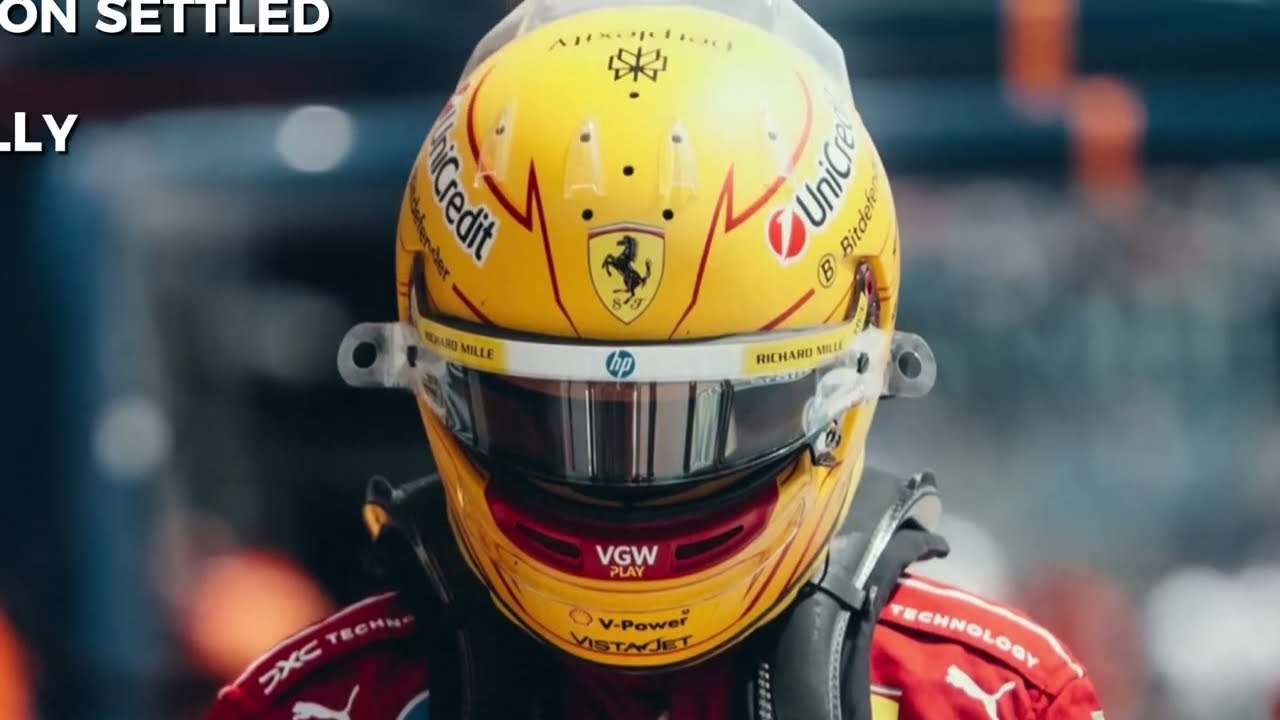
This is precisely where Hamilton’s early throttle lift changes the entire equation. By releasing the accelerator pedal that fraction of a second early, he allows the immense aerodynamic drag of the Formula 1 car to act as a natural, invisible parachute. Even without touching the brake pedal, the car begins to decelerate rapidly simply due to air resistance. This initial, aerodynamic deceleration starts the process of weight transfer in a much smoother, more controlled manner. The front of the car begins to settle gently, rather than diving violently. The suspension absorbs the shifting load progressively. More importantly, the rear of the car remains stable, planted, and completely secure.
By the time Hamilton actually hits the brake pedal with maximum force, the car is already primed and stabilized. The violent shock to the chassis is entirely mitigated. Instead of fighting a bucking bronco, he is guiding a perfectly balanced machine into the braking zone. This immense stability grants him a profound psychological and physical advantage. He can approach the ultimate braking limit with absolute confidence, knowing the rear of the car will not betray him. The onboard footage of Hamilton perfectly illustrates this phenomenon. While other drivers are visibly sawing at the steering wheel, making frantic corrections as they battle the physics of deceleration, Hamilton’s hands remain incredibly still. The car looks serene, almost slow, completely devoid of the chaotic drama that usually accompanies a two-hundred-mile-per-hour braking event.
But the benefits of this early lift extend far beyond just keeping the car pointing straight. The secret to ultimate cornering speed lies in how the tires interact with the asphalt, and racing tires are notoriously sensitive entities. They generate their maximum potential grip when physical loads are applied to them smoothly and progressively. A sudden, violent shock—like transitioning instantly from full throttle to full brake—can overwhelm the molecular structure of the rubber, pushing the tire completely outside of its optimal operating window and instantly reducing the amount of grip available. By easing the car into the deceleration phase through his aerodynamic lift, Hamilton ensures that the load transfers onto the front tires gradually. The rubber adapts perfectly to the increasing forces, maintaining an incredibly consistent level of grip throughout the entire braking phase. This masterful tire management allows him to brake deeper and more effectively, entirely neutralizing the tiny fraction of a second he seemingly lost by lifting the throttle early.
Furthermore, this perfectly balanced platform sets up the holy grail of modern racing technique: trail braking. As the driver begins to turn the steering wheel to enter the corner, they must gradually release the brake pedal. This delicate overlap of braking and turning is known as trail braking, and it is arguably the most difficult skill for a racing driver to master. If a driver carries too much brake pressure while turning, the front tires will lock up or push wide, ruining the line. If they release the brakes too early, the front of the car lifts, weight transfers back to the rear, and the car refuses to turn into the apex. Because Hamilton arrives at the turn-in point with a completely settled, stable car, his transition into trail braking is utterly seamless. The car obeys his steering inputs with microscopic precision. He dictates the angle and the rotation of the chassis effortlessly, positioning the car on the absolute perfect geometrical line through the complex corner.
This is where the grand finale of the “Hamilton lift” reveals itself in spectacular fashion. The ultimate goal of any corner is not necessarily to carry the highest possible speed into the turn, but rather to achieve the highest possible speed exiting the turn. Corner exit speed is the compounding interest of racing; an extra mile per hour gained at the exit of a corner is carried all the way down the subsequent straightaway, multiplying its value over distance. Because Hamilton’s entry into the corner is so smooth, stable, and perfectly positioned, he is able to rotate the car earlier than his rivals. He gets the nose of the car pointed down the next straightaway sooner. And because he is pointed straight sooner, he can get back on the accelerator pedal earlier and much harder than anyone else on the grid.
When you look at the complete picture of the cornering sequence, the sheer brilliance of the strategy becomes undeniably obvious. He sacrifices a minuscule, almost unmeasurable amount of speed at the very beginning of the braking zone. In return, he gains profound stability, preserves the delicate life of his tires, eliminates the need for speed-scrubbing steering corrections, dictates the perfect line through the apex, and launches out of the corner with terrifying efficiency. It is the ultimate manifestation of the age-old racing adage: “slow in, fast out,” elevated to a level of absolute scientific perfection.
What is perhaps most remarkable about this technique is that it perfectly encapsulates Lewis Hamilton’s broader philosophy as a racing driver. Throughout his illustrious career, he has frequently been described by commentators and peers as an incredibly “smooth” driver. However, this smoothness is often misunderstood as a passive or effortless quality. In reality, as the telemetry data vividly proves, his smoothness is a highly aggressive, deliberate, and fiercely controlled orchestration of physics. Every single input he makes into the steering wheel and the pedals is meticulously timed to maintain the perfect harmony of the car’s balance.
In a sport that constantly glorifies aggression and edge-of-your-seat, chaotic car control, Hamilton has proven that supreme speed is often found in the quiet moments between the violent actions. The early throttle lift is a testament to an intellectual approach to racing, an understanding that forcing a car to do something it hates is rarely the fastest way around a complicated circuit. By working in tandem with the physical limitations of the machine, by preparing the car for the violence of the corner before it even begins, he unlocks a level of true performance that sheer bravery alone can never achieve.
The next time you watch a Formula 1 race, pay close attention as the cars approach a heavy braking zone. Look past the blinding speed and the dramatic sparks flying from the underbody. Listen carefully to the subtle drop in the engine note. Watch the calmness of the chassis as it dives into the turn. You will be witnessing a masterclass in vehicle dynamics, a silent, invisible technique that has completely redefined what it means to drive fast. It is a striking reminder that in the relentless pursuit of perfection, sometimes the most powerful thing you can do is simply let go, just a fraction of a second before everyone else.