In the high-octane world of Formula 1, results are usually the only currency that matters. You are as good as your last race, your last lap, your last corner. By that metric, Lewis Hamilton’s 2025 season was a catastrophe. It was a year that saw the seven-time world champion finish sixth in the standings, his lowest-ever points tally, and endure the indignity of being out-qualified by his teammate 19 times.
It was a season of “nightmares,” public admissions of struggle, and a car that seemed to fight him at every turn. Yet, amidst the wreckage of a season that looked like a career-ending slump, Hamilton did something bizarre. He looked into the cameras, unflinching, and declared that “Ferrari’s winning mentality is back.”
To the casual observer, this sounded like delusion. How could a team that finished a distant fourth, miles off the pace of McLaren and Red Bull, possess a winning mentality? But as the dust settles and the paddock looks toward the revolutionary 2026 regulations, a different picture is emerging. It is becoming increasingly clear that what looked like a collapse was, in fact, one of the most audacious strategic gambles in modern motorsport history. Ferrari didn’t lose their way in 2025; they simply stopped looking at the map everyone else was following.

The Calculated Sacrifice
The narrative of Ferrari’s decline in 2025 was written in the timing sheets, but the real story was being penned in the executive offices of Maranello as early as April. That was when Team Principal Fred Vasseur made a call that would have terrified a lesser leader. He effectively pulled the plug on the SF-25. In a sport where standing still is moving backward, Vasseur ordered his engineers to down tools on the current car and shift their entire focus to the unwritten future of 2026.
This decision helps explain the inexplicable drop in form. The reason Hamilton and Charles Leclerc were fighting an unpredictable machine that refused to improve wasn’t incompetence; it was neglect. While their rivals were bringing upgrade packages to every European round, refining their floors and wings for tenths of a second, Ferrari’s aerodynamicists had already moved on. They were working on a ghost car, a machine that wouldn’t see a track for another year.
The psychological toll of this strategy was immense. Driving a car that you know isn’t getting better is a special kind of torture for a racing driver. It explains the frustration we heard over the radio and the dejected body language in the paddock. But it also explains Hamilton’s strange optimism. He wasn’t looking at the 2025 data; he was looking at the 2026 simulations. He knew that the pain of the present was the down payment for future dominance.
Injecting the Mercedes DNA
One of the most compelling aspects of this turnaround is not just what Ferrari is building, but who is building it. For years, Ferrari has been accused of being too insular, too reliant on promoting from within a culture that often stifled innovation through fear of failure. Vasseur has taken a sledgehammer to that philosophy.
The arrival of Loic Serra as Chassis Technical Director is a game-changer. Serra isn’t just another engineer; he is a veteran of Mercedes’ golden era. He spent 14 years at Brackley, overseeing vehicle performance during a streak of eight consecutive Constructors’ Championships. He knows what a winning car feels like, not just in theory, but in practice. He understands the suspension geometries, the tire interactions, and the chassis dynamics that allowed Lewis Hamilton to dominate the sport for nearly a decade.
Joining him is Jerome d’Ambrosio, another Mercedes alum, taking on the role of Deputy Team Principal. This isn’t just headhunting; it’s a transfusion. Ferrari is actively injecting “Mercedes DNA” into its bloodstream. They are importing the processes, the rigor, and the calmness under pressure that defined the German team’s success. When Hamilton walks into the garage now, he sees familiar faces and, more importantly, familiar methodologies. He isn’t just joining Ferrari; he is joining a team that has been rebuilt to accommodate the very standards he helped set at Mercedes.

The Hidden Weapon: Wind Tunnel Time
Perhaps the most lethal weapon in Ferrari’s arsenal for 2026 is one that was gifted to them by their own failure. Formula 1’s aerodynamic testing regulations are designed to create parity: the worse you do, the more time you get in the wind tunnel. By finishing fourth in the 2025 Constructors’ Championship, Ferrari unlocked a treasure trove of development time.
For the first critical half of 2026, Ferrari is permitted 1,021 hours of wind tunnel testing. Compare that to McLaren, the reigning champions, who are restricted to just 840 hours. That gap of nearly 180 hours is colossal. In the world of F1 aerodynamics, that translates to roughly 48 extra days of testing, or around 300 additional CFD (Computational Fluid Dynamics) runs.
When you are refining an existing concept, extra time is helpful. But when you are designing a car for completely new regulations—new active aerodynamics, new chassis dimensions, new power units—that extra time is everything. It allows Ferrari to explore concepts that McLaren and Red Bull simply don’t have the bandwidth to test. While the champions are forced to commit to a design path early, Ferrari can afford to experiment, refine, and perfect. They are starting the 100-meter dash with a 20-meter head start.
A Technological Revolution
The transformation at Maranello isn’t just about people and hours; it’s about hardware. The team has utilized the “quiet” period of 2025 to overhaul their physical infrastructure. The wind tunnel has been upgraded with a new rubberized rolling road system, offering a correlation between simulation and reality that they have lacked for years. Their new simulator, built in partnership with Dynisma, operates with lower latency than almost anything else on the grid, giving drivers a more realistic feel of the car long before it hits the tarmac.
The SF-26, the car born from this intense preparation, already marks a radical departure from Ferrari’s recent history. The switch to a pull-rod front and push-rod rear suspension setup signals an aggressive new aerodynamic philosophy. It suggests a car designed to generate stable, predictable downforce—the holy grail for a driver like Hamilton, who thrives on late braking and precision corner entry.
The “Now or Never” Moment
Despite all the preparation, the specter of Ferrari’s history looms large. The Tifosi have been here before. They remember 2017 and 2018, where Sebastian Vettel led the championship only for the team’s operations to crumble under pressure. They remember the strategic blunders that cost Charles Leclerc in 2022. Ferrari’s problem has rarely been building a fast car; their problem has been winning a championship.
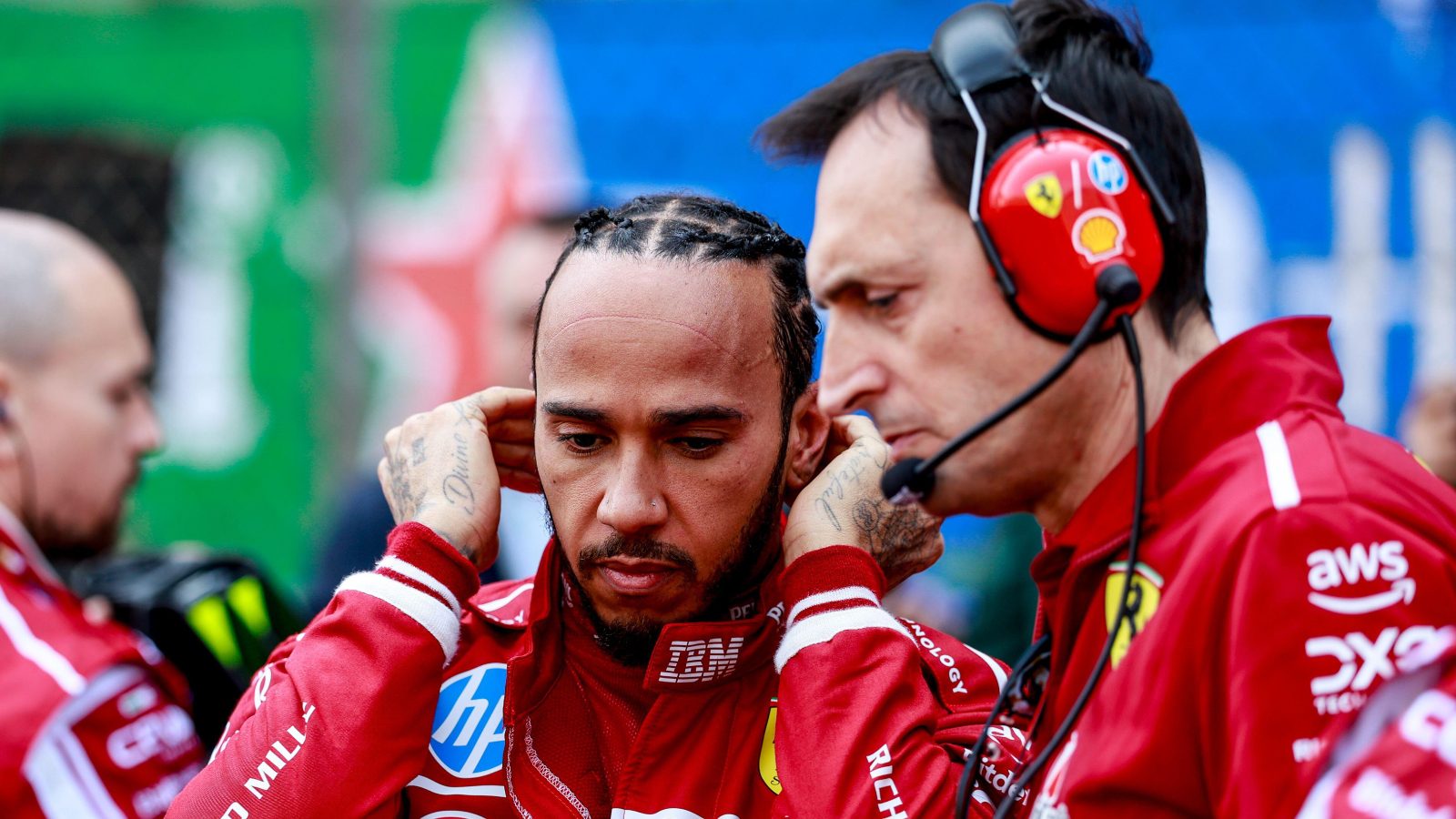
This is where the “Hamilton Factor” truly comes into play. Lewis Hamilton didn’t move to Ferrari just to drive; he moved to lead. His comments about the “winning mentality” are as much a challenge to his team as they are a statement of fact. He is demanding perfection. The removal of his race engineer after a season of tension shows that the team is listening. They are willing to make the uncomfortable changes necessary to support their star driver.
We are looking at a Ferrari team that has stripped itself down to the studs and rebuilt itself with a singular purpose. They have the time, they have the talent, and they have the resources. The “nightmare” of 2025 was a necessary darkness before the dawn.
As the 2026 season approaches, the paddock is beginning to realize that they may have miscalculated. They thought they were watching a giant stumble, but in reality, they were watching a predator crouch. Lewis Hamilton has bet his legacy on this move. If the simulations in Maranello are correct, that bet is about to pay out in a way that will leave the rest of Formula 1 in absolute shock. The Prancing Horse is not just galloping; it is ready to trample the competition.