If you watched the private Formula 1 testing sessions in Barcelona and felt a mix of exhilaration and confusion, you are not alone. The cars look different, the regulations have been overhauled, and the grid has been shuffled. But as the F1 circus descends on Bahrain for the official pre-season test, a dangerous illusion is taking hold of fans and pundits alike. The timing screens are lighting up with purple sectors, and social media is ablaze with predictions of who has built the “rocket ship” of 2026.
But here is the hard, uncomfortable truth: Everything you think you see on that timing screen is likely a lie.
The Bahrain test is not just about speed; it is a complex poker game where teams bluff, sandbag, and hide their true potential. However, amidst the smoke and mirrors, there are real clues—if you know where to look. From Lewis Hamilton’s startling feedback to the invisible war over fuel loads, here is the deeper reality of the 2026 season that the highlights won’t show you.

The Lap Time Trap: The Most Dangerous Metric
It is the most natural instinct in motorsport: look at the leaderboard, see a driver at the top, and assume they are the favorite. In pre-season testing, this instinct is wrong. In fact, lap times can be the most misleading piece of data you will see all year.
Why? The answer lies in the fuel tank. In F1, weight is the enemy of speed. Every 10 kilograms of fuel adds roughly three-tenths of a second to a lap time. During testing, teams run vastly different fuel loads. One car might be blazing a glory run on empty tanks to grab headlines, while a rival is circulating three seconds slower with a full tank, gathering crucial race-simulation data.
A car that looks slow might actually be the fastest machine on the grid, simply weighed down by sandbagging and fuel. Conversely, a “fast” car might be running on fumes and soft tires just to appease sponsors. Unless you know the fuel load—which the teams guard like state secrets—the P1 slot is meaningless. As we head into Bahrain, the smartest fans are those who ignore the stopwatch and watch the stints.
Reliability: The Silent Killer of Hopes
If speed is an illusion, what is real? Reliability. In a year of sweeping regulation changes, with new power units and chassis concepts, the ability to simply keep the car running is the ultimate currency.
We saw a glimpse of this in the private Barcelona running. While some teams were frantically firefighting in the garage, losing hours of precious development time, Mercedes quietly went about their business. The Silver Arrows racked up an enormous lap count, signaling that their fundamental package—cooling, electronics, and power unit integration—is bulletproof.
This is the metric that matters. A car that breaks down in testing is a car that isn’t learning. In the compressed timeline of F1, lost laps are lost championships. When watching the Bahrain streams, don’t look for the fastest lap; look for the team that never seems to be in the garage. If a team is pounding round and round while others are dismantling their cars behind screens, you are looking at a potential title contender, regardless of their lap time.

Hamilton’s “Snappy” Warning: A New Era of Driving
The 2026 cars aren’t just technically different; they are beasts to drive. The new regulations have produced machines that are lighter, smaller, and powered by a radical 50/50 split between internal combustion and electrical energy.
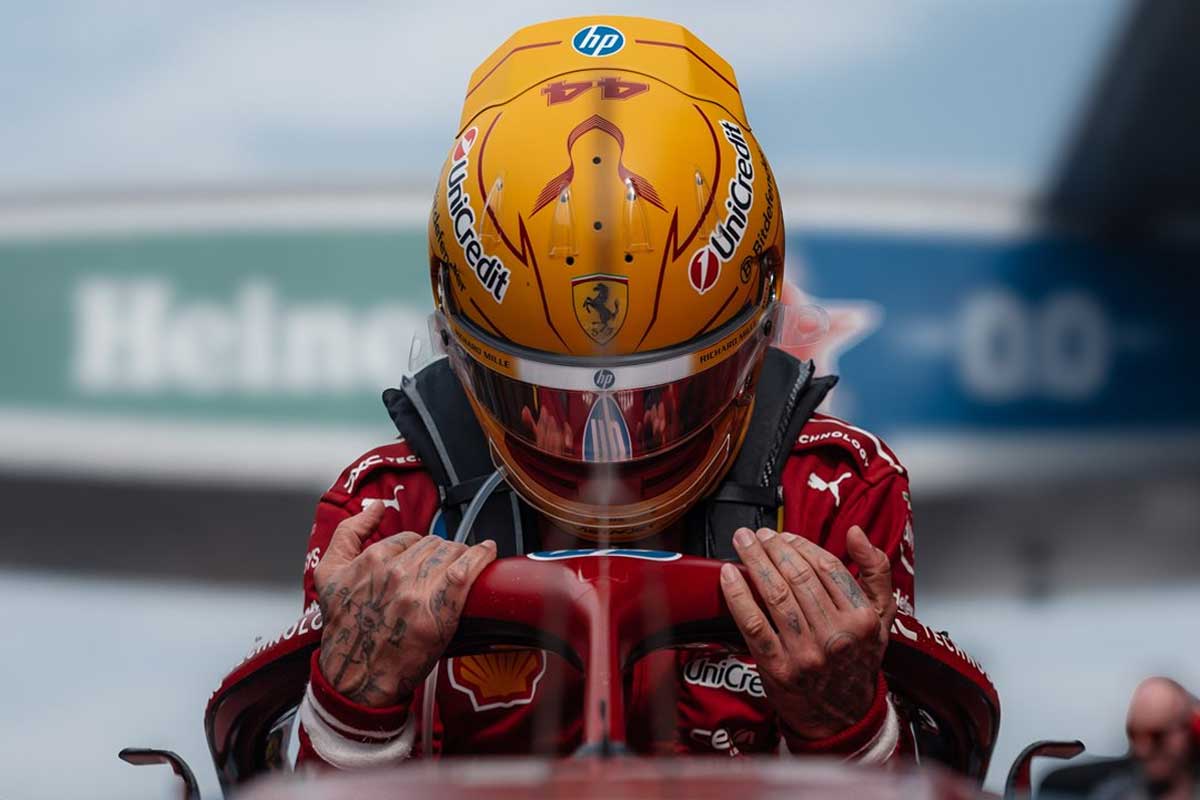
Lewis Hamilton, a veteran who has driven everything from V10 screamers to hybrid monsters, provided one of the most telling insights so far. His verdict? The new cars are “snappy” and “oversteery.”
This is a massive departure from the planted, rail-like cars of the previous era. “Snappy” implies a car that is on a knife-edge, one that bites back if you push it too far. While this sounds terrifying for the engineers trying to set up the car, Hamilton admitted it is “more fun to drive.” This suggests a return to a raw, driver-centric formula where talent can make a bigger difference than pure engineering. Watch the on-board cameras in Bahrain. If you see drivers wrestling the steering wheel and correcting slides on corner exits, don’t mistake it for a bad car—it might just be the new normal.
The Active Aero Gamble
The most futuristic addition to the 2026 grid is “Active Aerodynamics.” For the first time, front and rear wings will actively open and close during the lap to reduce drag on straights and increase downforce in corners.
It sounds perfect on paper, but in reality, it is a technical minefield. During early runs, we’ve already seen divergent philosophies. Ferrari’s system appears to operate with a decisive, clean snap. Other teams? Not so much.
In Bahrain, watch the rear wings closely. Do they flutter? Is there a delay between the driver hitting the brake and the wing re-engaging? Any hesitation in this system creates instability, stripping the driver of confidence entering a corner. If a team’s active aero isn’t working in perfect harmony, they aren’t just losing time; they are risking crashes.
The Invisible War: Sustainable Fuel
Finally, there is the variable you can’t see but will definitely feel: the switch to 100% sustainable fuels. This isn’t just a PR stunt; it fundamentally changes how the engine burns and delivers power. The combustion properties are different, and teams are scrambling to adapt.
This is where Aston Martin may have played a masterstroke. Their partner, Aramco, has been supplying sustainable fuels to Formula 2, giving them a treasure trove of real-world data that other suppliers lack. While rivals are calibrating their engines to stop them from knocking or misfiring with the new brew, Aston Martin might be fine-tuning for performance.
The Verdict: Watch with Your Eyes, Not the Clock
As the engines fire up in Bahrain, remember the golden rule of testing: Context is King.
Ignore the “glory runs.” Instead, watch for the cars that can follow closely without dropping back, testing the promise of reduced “dirty air.” Watch for clean, stutter-free launches as drivers manage the new electrical torque. Watch for the teams that run all day without opening the toolbox.
The 2026 season is a blank slate. The team that wins in Melbourne won’t necessarily be the one that tops the charts in Bahrain—it will be the one that understood the assignment while everyone else was chasing headlines.