Let me ask you something fundamental about the recent Japanese Grand Prix: did Lewis Hamilton genuinely lose his grip on that podium at Suzuka, or was it forcibly and ruthlessly taken from him? If you simply watched the international broadcast of the race, absorbing the action strictly on the surface, you might have easily concluded that the legendary driver simply lacked the raw pace. You might have even convinced yourself that Lewis just did not have the magic this particular weekend, settling for the narrative that the seven-time world champion was merely outdriven by his younger rivals. But the reality lurking beneath the timing screens is vastly more brutal, undeniably complex, and honestly, entirely shocking. This was absolutely not a matter of driver error.
This was not a failure of racecraft, nor was it a strategic blunder from the pit wall. Instead, this was the story of a hidden, catastrophic fifteen percent power loss that effectively turned his prized Ferrari into something completely unrecognizable on the circuit. Once you peel back the layers and examine the raw telemetry data, the truth is glaring, and you simply cannot unsee it.
Right after the safety car period—a golden opportunity gifted by a massive crash earlier in the session—everything seemed to be lining up perfectly for Hamilton. He had secured a free pit stop, maintained crucial track position, and was sitting comfortably in third place. By all conventional racing metrics, this scenario should have translated into a textbook podium finish.
It was exactly the kind of high-pressure, late-race situation where sheer experience traditionally wins out, where Lewis historically manages his tires perfectly, manipulates the gap to the cars behind, and masterfully brings the machine home to the checkered flag. However, within just a few laps of the safety car restart, that guaranteed podium was completely gone. It did not slip away slowly or gradually through expected tire degradation; it was violently ripped away from his grasp. The telemetry data tells a harrowing story: Hamilton’s car was effectively slamming into an invisible electrical wall approximately three hundred meters before every major braking zone.
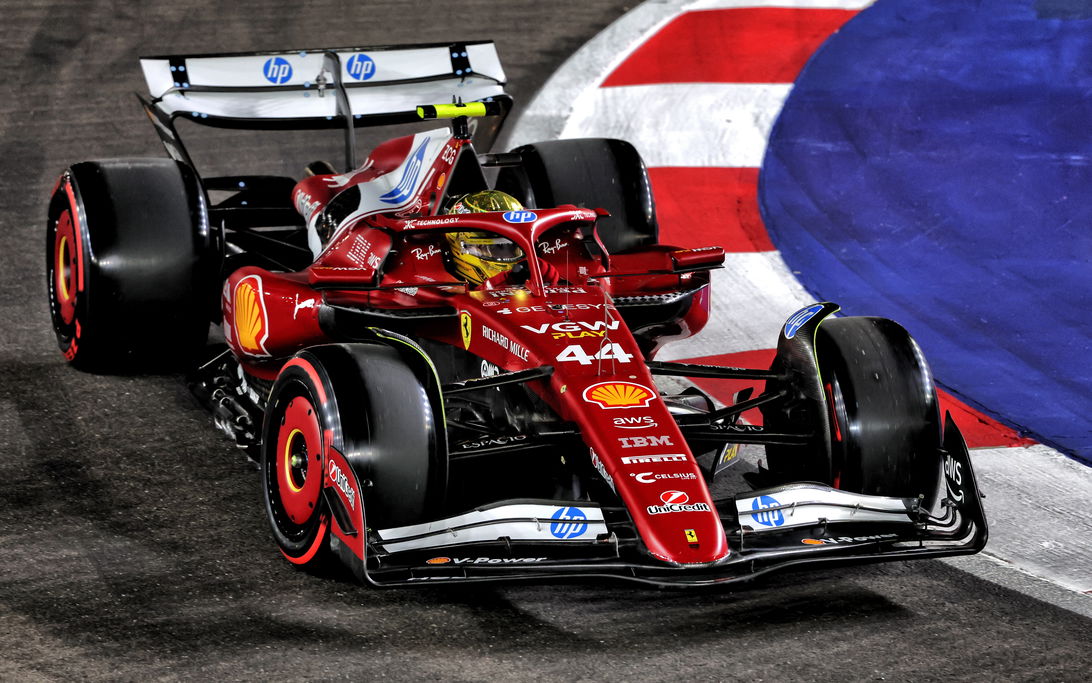
Imagine the sheer frustration of piloting a modern Formula 1 car, going full throttle down one of the most iconic straights in motorsport, fully expecting that familiar, violent surge of hybrid power to carry you forward. Instead of accelerating into the distance, the car simply plateaus. There is no sustained push, no aggressive acceleration—just an overwhelming sense of drag holding the vehicle back as rivals breeze past as if you are standing completely still. Now, compare that terrifying scenario to what was unfolding on the exact same afternoon on the other side of the Ferrari garage. It was the same car, the same engineering team, but a completely different and far more successful story. We are talking about an astonishing pace deficit of nearly two seconds per lap between two elite Ferrari drivers. In the hyper-competitive world of Formula 1, a gap of that magnitude is not merely significant; it is a giant, waving red flag. It is the kind of massive discrepancy that loudly screams that something is fundamentally and mechanically wrong with the equipment.
Hamilton recognized the terminal issue immediately. You could hear the raw disbelief and growing agitation in his radio communications back to his race engineer, and you could physically see the dejection in his body language after he climbed out of the cockpit in parc fermé. He was not confused by the lack of pace; he was profoundly frustrated. When a driver of his caliber executes every single variable perfectly—flawless tire management, ideal track positioning, perfect defensive lines, and seamless strategy—only to get swallowed whole on the long straights like a complete amateur, they know instantly that the mathematics of the race are not adding up. This profound betrayal by the machinery demands a closer investigation into the actual mechanics of the Ferrari power unit, because understanding the science behind this failure completely shifts the blame away from the driver and squarely onto the shoulders of the engineering department in Maranello.
That debilitating three-hundred-meter power loss was not a random glitch or a stroke of terrible luck. It has a specific technical name, a definitive mechanical cause, and it might just represent the single biggest hidden weakness in Ferrari’s entire ambitious 2026 car design. To truly comprehend the severity of the issue, we must break down the real silent killer in this unfolding championship drama: MGUK clipping. If you are not deeply immersed in the highly technical, engineering-heavy side of Formula 1, the concept can be simplified into a devastating reality. Every modern Formula 1 machine utilizes a complex hybrid energy recovery system designed to store massive amounts of electrical energy during braking, which is then dynamically deployed to provide explosive extra power—essentially a massive, sustained boost when the driver buries the throttle pedal into the floor.

However, there is a brutal catch to this modern technological marvel. That stored electrical energy is strictly finite. Once the internal battery pack hits its mandated lower deployment limit, the computer system forcefully cuts off that supplementary power. That exact, momentum-killing moment is known in the paddock as “clipping.” Under normal circumstances, championship-winning teams manage this energy drain with perfect precision. The ultimate engineering goal is to seamlessly spread that finite electrical energy across the entire length of the straight, ensuring the driver enjoys smooth, consistent, and relentless acceleration all the way until they hit the brakes for the upcoming corner. That perfect harmony is exactly what powerhouse teams like Mercedes and McLaren are currently executing week in and week out, and it is precisely why their cars look so incredibly strong, stable, and unbeatable in a straight line battle.
Ferrari’s current reality, however, is a completely different, nightmarish story. The unarguable telemetry data explicitly shows that Hamilton was not just experiencing standard clipping; he was clipping dangerously early, effectively running out of hybrid juice a staggering three hundred meters before the corner approach. This catastrophic timing meant that for a massive portion of the fastest sections of the track, he possessed absolutely zero electrical boost. He was entirely reliant on raw, unassisted internal combustion engine power, desperately trying to fight against the suffocating drag of his own aerodynamic package. And tragically for Hamilton’s race, the situation was even worse than a simple empty battery. This was not a routine clipping issue; this was a severe case of thermal derating. The hybrid system was actively overheating to dangerous levels, forcing the internal software to step in autonomously to protect the delicate internal components by heavily slashing power output by roughly fifteen percent.
Take a moment to truly internalize that nightmare scenario. You are a professional driver aggressively navigating a straight at full throttle, fully demanding maximum power to defend your podium position, and instead, the highly advanced computer inside your vehicle is literally holding the engine back to prevent itself from exploding. That is precisely why Hamilton described the horrifying sensation of the car continuously losing power—because, in a very literal, mechanical sense, it actively was. Meanwhile, his direct rivals on the track were still deploying their electrical energy smoothly, gaining precious meters with every passing fraction of a second. This incredibly localized power failure is exactly why looking solely at the top speed traps can be dangerously misleading. While the ultimate top speed numbers might appear somewhat competitive on a simple piece of paper, they fail to illustrate how agonizingly long it took the Ferrari to reach that speed, or how much time was violently hemorrhaged along the way. Hamilton was reaching his peak velocity far too late on the straight, and by the time he finally arrived at those speeds, the defensive damage was already fully done and his rivals were long gone.
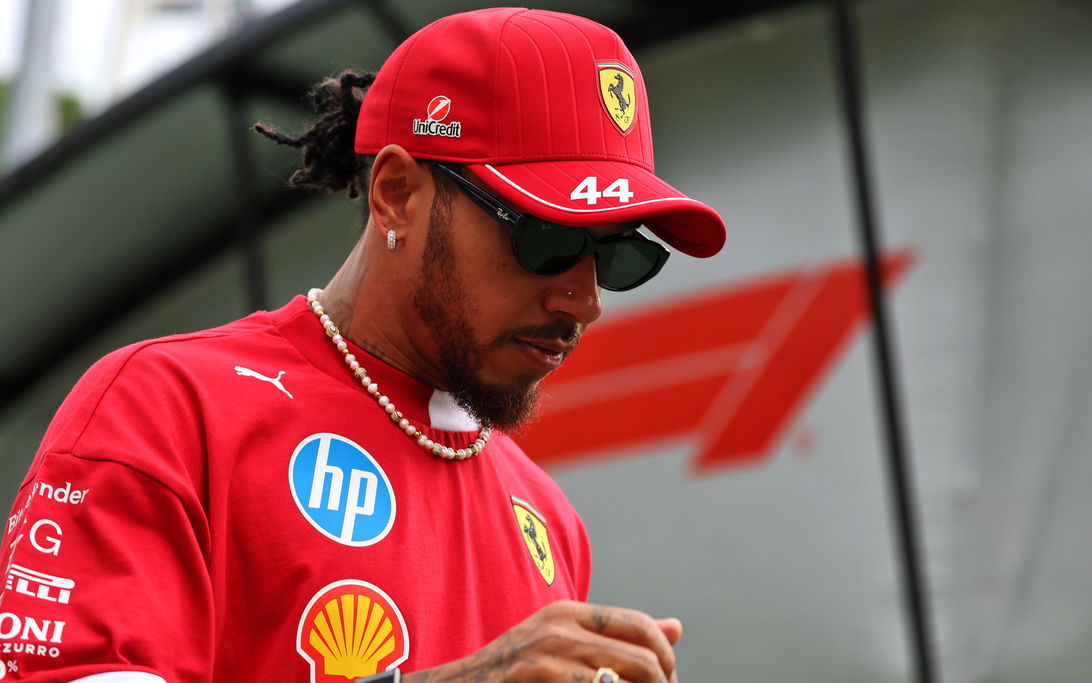
Now, we must address the most compelling and controversial mystery surrounding this entire disaster: why was this extreme thermal derating happening so severely to Hamilton, yet seemingly not affecting his teammate to the same catastrophic degree? This is the million-dollar question that the brilliant minds at Ferrari must urgently answer. One highly credible theory within the paddock—and honestly, one that makes complete logical sense given the circumstances—is that Hamilton was essentially forced into aggressively overusing his allocated electrical energy entirely too early on the corner exits. Because he fundamentally lacked trust in the unpredictable, unstable rear end of the car as he accelerated out of the slow-speed turns, he was heavily relying on the manual overtake boost simply to stay within striking distance of the leaders. But by mashing that deploy button earlier and harder to compensate for mechanical grip issues, he was rapidly draining his battery reserves at an unsustainable rate.
This desperate driving tactic quickly created a vicious, unavoidable cycle. You aggressively drain the battery to survive the corner exit, you subsequently hit the dreaded clipping phase hundreds of meters earlier on the straight, the overworked internal system dramatically overheats, the protective software forcefully steps in to slash power by fifteen percent, and suddenly you are completely trapped. The car becomes a sitting duck, unable to physically recover its energy or defend its track position. This technical paradox directly transitions the conversation from a mere software glitch into a full-blown, foundational aerodynamic design crisis for the Italian outfit. Even if Ferrari’s engineers miraculously patch the MGUK clipping issue overnight with a software update, they are still fighting a much larger, more terrifying enemy built directly into the carbon fiber of the car itself: immense aerodynamic drag.
The current iteration of the SF26 is not just mildly inefficient through the air; it currently stands as one of the highest drag vehicles on the entire grid. At an incredibly fast, flowing circuit like Suzuka, possessing a draggy car is basically a competitive death sentence. The vehicle produces immense downforce in the sweeping corners, which perfectly explains why it looks so incredibly fast and planted during the first sector of the lap. But the very second the car exits those high-speed corners and attacks the long straights, all of that beneficial downforce instantly transforms into a massive wall of atmospheric resistance. Normally, the hybrid electrical system is the weapon used to punch through that invisible wall, providing the required grunt to overcome the drag penalty. But without that electrical assistance, Hamilton was left pushing a parachute down the track against the most aerodynamically efficient cars in the world.
Adding absolute insult to injury is the frustrating reality of Ferrari’s abandoned aerodynamic solutions. The team had hyped up a massive, innovative upgrade known internally as the “Macarena wing”—an active aero concept specifically designed to shed this exact type of straight-line drag while magically maintaining cornering stability. On paper, it was the brilliant silver bullet they desperately needed to close the gap to the front. In reality, they did not even bolt it onto the car for the race. Management delayed the highly anticipated upgrade, pulled it back at the last second, and officially decided it was simply not ready for competition. That lack of confidence speaks absolute volumes. If a team cannot trust its most crucial aerodynamic upgrade at one of the most aero-sensitive venues on the entire calendar, the underlying structural problems run deeper than anyone is willing to admit publicly.
Ultimately, this profound divergence in performance highlights a massive internal split regarding driving styles. Hamilton is notoriously methodical, incredibly precise, and demands a car that behaves with absolute, unwavering consistency. He builds his legendary confidence through a predictable machine. The current Ferrari, however, is a twitchy, nervous, unpredictable beast that outright refuses to give him the stability he requires to commit to the throttle early out of challenging corners like Spoon. His teammate, possessing a more reactive and aggressive driving style, seems slightly more willing to wrestle with the inherent instability, somehow extracting lap time even when the platform is fundamentally flawed. But relying on a driver to continuously out-drive a bad car is never a sustainable recipe for a world championship campaign. Ferrari executed perfectly on the pit wall with strategy and stops, yet they still comprehensively failed their star driver on the actual track. The pressing question heading into Miami is no longer if Ferrari can catch Mercedes or McLaren, but whether they can fix their profoundly flawed machine before their entire 2026 season completely falls apart.
