The dust has barely settled on the Albert Park circuit in Melbourne, yet the tectonic plates of Formula 1’s new 2026 era are already shifting with violent intensity. While the history books will record a Mercedes victory for George Russell at the season opener, the real story wasn’t found on the podium. It was found in the data traces, the hushed whispers echoing through the paddock, and the sudden, aggressive pivot coming out of Maranello. Ferrari is no longer content with being the “best of the rest.” They have seen blood in the water, and they are moving for the kill far earlier than anyone anticipated.
The 2026 season was heralded as a complete reset, a blank canvas where the giants of the sport would have to relearn everything. In Melbourne, Mercedes appeared to have found the first rhythm, but beneath that silver veneer, a scarlet shadow was looming. Charles Leclerc and Lewis Hamilton brought their Ferraris home in a solid points haul, but it was the manner of their performance that sent shockwaves through the rival garages. Ferrari wasn’t fading in the closing laps; they were hunting. They were stable, they were consistent, and most importantly, they were fast in places that traditionally define a championship-winning car.
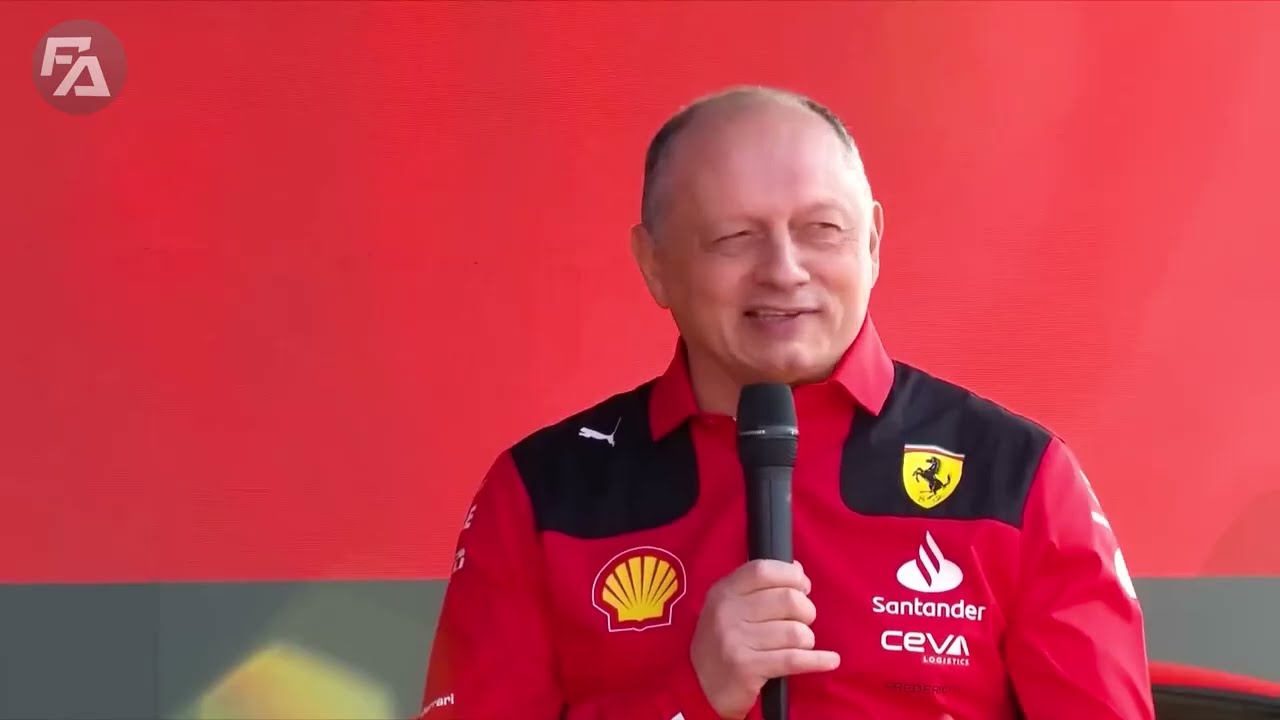
Team Principal Fred Vasseur, the man tasked with returning the world’s most famous racing team to its former glory, hasn’t wasted a second. His post-Melbourne address to the team was devoid of the typical corporate platitudes. Instead, it was a call to arms. “The goal is to work harder and more intensely than the others,” Vasseur stated with a sense of urgency that has become his trademark. “Hurry up and get to Mercedes as soon as possible.” That “hurry up” has manifested in a development acceleration that has caught the entire grid off guard.
Originally, Ferrari’s first major aerodynamic overhaul for the SF-26 was slated for the Bahrain Grand Prix. It was a logical, safe, and calculated plan. However, the volatile nature of the current global landscape and potential shifts in the 2026 calendar have forced Ferrari’s hand. Rather than waiting for a “safer” window, the Scuderia has decided to bring their most potent upgrades forward to the Chinese Grand Prix. This is not just a minor tweak to a front wing endplate; this is a fundamental evolution of their aerodynamic philosophy.
At the center of this firestorm is the “Macarena wing”—a nickname that has already become legendary in the pit lane. Reports suggest that Ferrari is shipping not one, but three distinct specifications of this radical rear wing concept to Shanghai. This is an almost unheard-of move for a top-tier team this early in the season, especially during a Sprint weekend where practice time is limited to a solitary hour. By bringing three versions, Ferrari is effectively conducting a live, high-stakes science experiment in front of millions of fans. They are looking for the “sweet spot” of aerodynamic efficiency that could nullify Mercedes’ current power advantage.
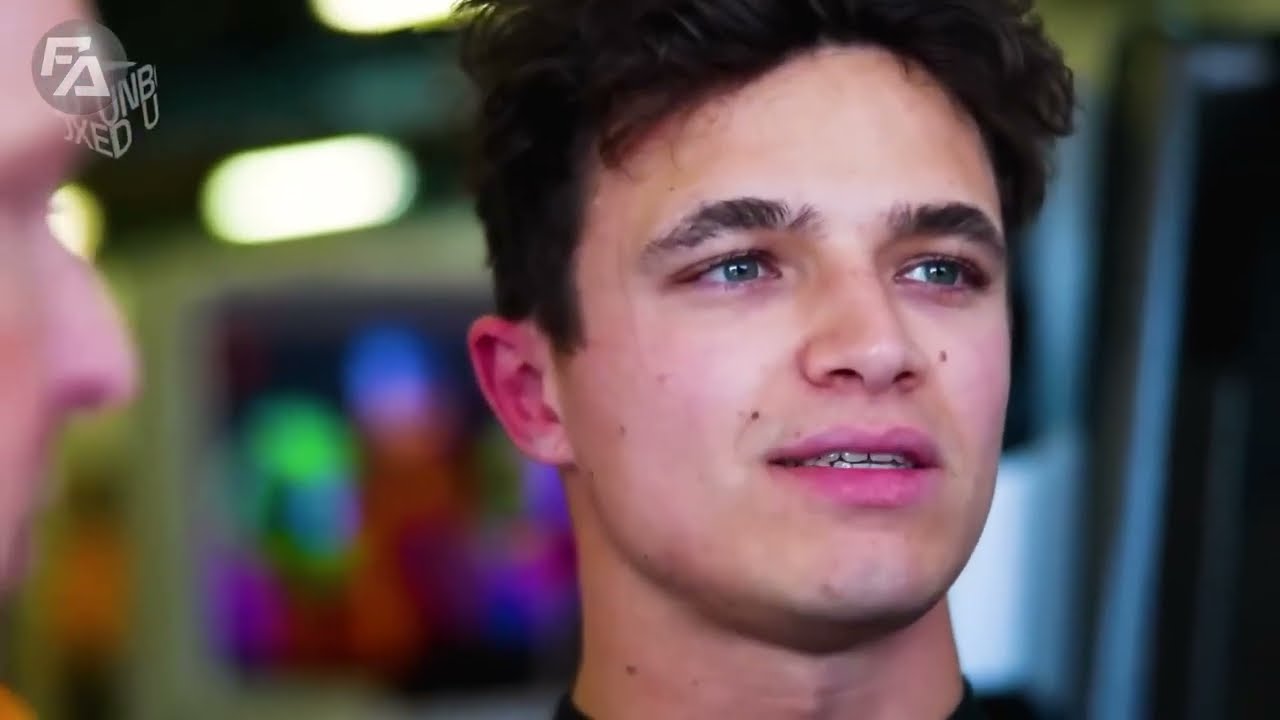
The confidence radiating from Maranello is backed up by an unlikely source: their rivals. Lando Norris, who found himself a distant spectator to the Ferrari-Mercedes battle from his McLaren cockpit, was brutally honest about what he saw on track. “I think Ferrari, from what we see quite clearly, they have the best car,” Norris admitted. “Their cornering speeds are unbelievable.” Coming from a driver of Norris’s caliber, “unbelievable” isn’t a word used lightly. He pointed out that while Mercedes might have the edge in pure system integration, the Ferrari SF-26 chassis is the class of the field when the steering wheel is turned.
This “unbelievable” cornering speed is exactly why the Chinese Grand Prix has become the focal point of the early season. The Shanghai International Circuit is a graveyard for cars with poor mechanical balance. From the agonizingly long, tightening spiral of Turn 1 to the high-load, high-speed Turn 13 that leads onto the massive back straight, the track demands a car that can lean on its tires without protesting. If Ferrari’s strength is indeed its chassis stability and mid-corner rotation, Shanghai could be the place where the SF-26 officially ends the Mercedes honeymoon phase.
The numbers coming out of the McLaren camp further highlight the mountain Ferrari has already climbed. Norris estimated that his team is currently 0.5 to 0.6 seconds per lap behind the lead pack—a gap he described as a “very, very long way off.” For McLaren, the struggle is about understanding the complex 2026 power unit software. For Red Bull, the transition to becoming their own engine supplier has brought predictable teething issues. This has left a vacuum at the front of the grid, one that Ferrari is filling with aggressive mechanical innovation.

Perhaps the most frustrating realization for Mercedes is that their Melbourne win was partially gifted by circumstance. The data suggests that the gap between Russell and Leclerc was largely solidified during a Virtual Safety Car period. Before that strategic shuffle, the leading pack was inseparable. Crucially, the race winner never actually managed a conventional on-track overtake on the leading Ferrari. When it was man-against-man and machine-against-machine in the corners, the Ferrari held its ground.
Now, with the “Macarena” upgrades arriving, the SF-26 is poised to find the straight-line speed it lacked in Australia. The goal is simple: maintain the “unbelievable” cornering advantage while trimming the drag to match Mercedes on the straights. If the engineers in Maranello have found even half of the performance they expect, the power balance of the 2026 season will be fundamentally rewritten by Monday morning in Shanghai.
The decision to debut such complex parts during a Sprint weekend is the ultimate “Vasseur move.” It is risky, it is bold, and it signals a cultural shift within Ferrari. In years past, the Scuderia was often criticized for being too conservative, too afraid of failure to chase radical success. Those days are over. Under Vasseur, Ferrari is operating with the agility of a lean start-up and the resources of a superpower. They are embracing the chaos of the 2026 regulations, betting that their superior chassis foundation can handle the rapid-fire introduction of experimental parts.
As the F1 circus descends on China, the atmosphere is thick with anticipation. Will the three versions of the Macarena wing unlock the ultimate performance of the SF-26? Or will the lack of practice time lead to a high-profile stumble? Either way, the message from Italy is clear: Ferrari is not here to participate; they are here to dominate. The 2026 championship fight didn’t end in Melbourne—it’s only just igniting. And for the first time in a long time, the Prancing Horse looks like the one holding the matches.