When the Formula 1 circus descends upon the Shanghai International Circuit, one name inevitably rises above the roar of the engines: Lewis Hamilton. For over a decade, the seven-time world champion has treated the Chinese Grand Prix not just as a race, but as a personal masterclass in technical precision. Statistically, his record is nothing short of breathtaking. With six victories, multiple pole positions, and a collection of fastest laps that would make any contemporary rival envious, Hamilton has cemented himself as the undisputed King of Shanghai.
But as any seasoned racing enthusiast knows, statistics only tell half the story. The real intrigue lies in the “why”—the granular, data-driven reasons that explain how one man can consistently outpace the finest drivers on the planet at this specific 5.451-kilometer venue.
To understand Hamilton’s dominance, one must first appreciate the architectural complexity of the Shanghai International Circuit. Designed by the legendary Herman Tilke, the track is a technical gauntlet consisting of 16 corners that challenge every facet of a driver’s skill set.
From the high-speed commitment required in the middle sector to the heavy braking zones that punctuate the lap, Shanghai is a place where small errors are magnified into massive time losses. However, the most iconic and arguably most difficult section of the track is the very first corner—a tightening, 270-degree spiral that flows directly into turn two. This is where the legend of Hamilton’s technical superiority truly begins.
The Turn 1 and 2 complex is a nightmare for most drivers. It requires a specific technique known as “trail braking,” a discipline that Hamilton has mastered to a degree that borders on the supernatural. Most drivers are taught to brake in a straight line, release, and then turn. In the tightening spiral of Shanghai, that traditional approach is useless. Instead, Hamilton employs a progressive and incredibly precise method where he gradually releases the brake pedal while simultaneously increasing his steering angle. This shifts the car’s weight toward the front tires, allowing the nose to “bite” and rotate the car earlier into the apex. While other drivers often struggle with understeer—where the car refuses to turn and pushes wide—Hamilton’s smooth blending of braking and steering allows him to carry more entry speed while maintaining perfect control. It is a dance on the edge of physics that he executes with robotic consistency lap after lap.
Beyond the technical wizardry of his braking, Hamilton’s success in China is deeply rooted in his legendary tire management. The Shanghai circuit is notoriously “front-limited,” meaning the layout puts extreme stress on the front tires, particularly the front-left. As drivers navigate the long, loaded corners like the turn one spiral, heat builds up rapidly within the tire structure. If a driver is too aggressive with their steering inputs or suffers from frequent corrections, the tire surface overheats, the grip evaporates, and the lap time plummets. Hamilton’s driving style is characterized by its economy of motion. By minimizing unnecessary steering corrections and keeping the tires within their optimal “thermal window,” he preserves the life of the rubber far better than his peers. This allows him to maintain a searing pace during long race stints, often giving him a strategic advantage when rivals are forced to pit early due to degradation.

Another critical factor in the “Hamilton Equation” is his performance through the traction zones, specifically at the exit of turn 13. This corner leads onto one of the longest straights in all of Formula 1—a 1.2-kilometer stretch where cars exceed speeds of 340 km/h. Because the straight is so long, the exit speed from the preceding corner is of paramount importance. A mere 2 km/h advantage at the start of the straight can translate into a massive gap by the time the car reaches the braking zone at turn 14. Hamilton’s throttle application is famously precise; he begins to feed power to the rear wheels the exact millisecond the car has rotated enough, often earlier than the telemetry suggests is possible. This “early launch” provides him with a slingshot effect that makes him nearly impossible to overtake on the straight and a lethal predator when chasing down opponents.
However, the narrative of Hamilton’s Shanghai record is entering a transformative and uncertain new chapter. After a career-defining era with Mercedes, the British icon has made the seismic move to Scuderia Ferrari. This transition is perhaps the greatest challenge of his professional life. Every Formula 1 car is a unique beast with its own aerodynamic philosophy, suspension geometry, and power unit characteristics. A driving style that worked perfectly for the “Silver Arrows” may need significant adjustment to suit the “Prancing Horse.” For Hamilton, returning to Shanghai in a red suit will be the ultimate litmus test. Can his intrinsic understanding of the track’s rhythm overcome the hurdles of a new car? Will the Ferrari’s front-end stability allow him to utilize his signature trail braking, or will he be forced to reinvent his approach to the spiral?
The stakes have never been higher. The modern era of Formula 1 is dominated by the relentless pace of Max Verstappen and the technological might of Red Bull Racing. Younger stars like Lando Norris and Charles Leclerc are hungry to prove that the old guard’s records are meant to be broken. Yet, history suggests that we should never bet against Lewis Hamilton when he arrives in China. He possesses a psychological “map” of this circuit that few others can claim to understand. He knows exactly where the grip hides during a sudden rain shower and how to find the racing line when the track temperature drops. His adaptability—the ability to adjust his braking points and racing lines in real-time as conditions change—has saved his race on multiple occasions in Shanghai.
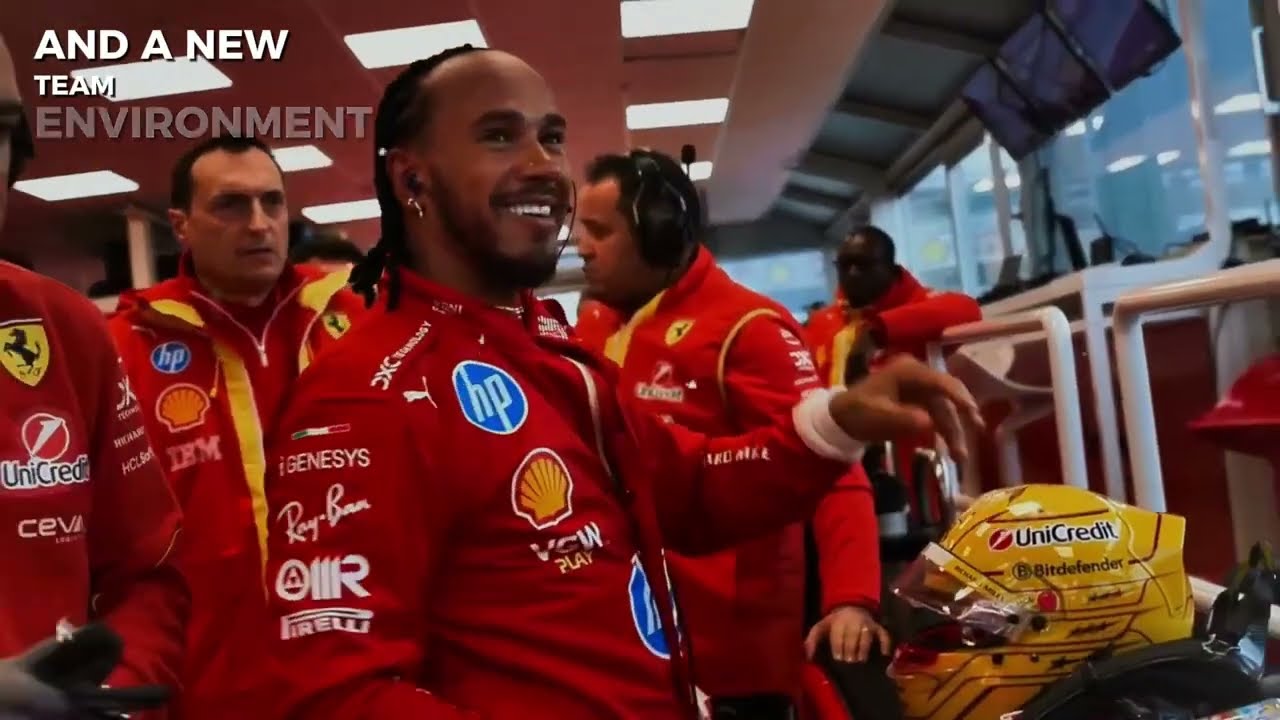
In many ways, the Shanghai International Circuit is a mirror that reflects a driver’s true caliber. It doesn’t just reward the fastest car; it rewards the smartest driver. It demands a delicate balance between aggression and conservation, between raw speed and tactical patience. Hamilton’s six wins are not a fluke of the hybrid era or a result of having the best engine; they are the result of a decade spent perfecting the art of the lap. Whether he is building his performance gradually to avoid early degradation or defending his position with late-braking heroics at turn 14, his intelligence behind the wheel is what truly separates him from the field.
As we look toward the future, the data remains clear: Lewis Hamilton’s record in Shanghai is a monument to technical excellence. While the car he drives may change and the rivals he faces may grow younger, the fundamental demands of the circuit remain the same. The “Master of the Spiral” will once again have to prove that his hands and feet can translate the data into victory. Whether you are a fan of the man or just a student of the sport, watching Hamilton navigate the complexities of China is watching a master at the height of his craft. The return to Shanghai promises to be more than just a race; it will be a high-speed interrogation of a legend’s legacy. Will the data hold true, or is a new king about to be crowned on the streets of Shanghai? One thing is certain: the world will be watching every braking zone and every apex to find out.