The dust of the recent Formula 1 season had barely settled when a flurry of clandestine activity began, not in hushed engineering offices, but in the glaring light of post-season testing and, shockingly, through a video editor’s catastrophic oversight. What we are witnessing is the opening salvo in the war for the World Championship—a technological arms race based on the most radical rule changes F1 has seen in a generation.
The new regulations mandate smaller, lighter, and more ‘nimble’ cars, powered by a heavily revised hybrid unit featuring a 50/50 split between combustion and electric power. Crucially, these rules introduce active aerodynamics—specifically, movable front and rear wings—designed to decrease drag on straightaways for better overtaking.
It is this fundamental shift that has pushed teams to debut prototype components months, perhaps even years, before they are officially ready. The early glimpses provided by Mercedes, Ferrari, and the ambitious newcomers at Cadillac have not just offered a sneak peek; they have unveiled three dramatically contrasting philosophies on how to conquer F1’s future.
The New Aero Battlefield: Front Wing Philosophies Revealed
The focus of much of this early testing has been the adjustable front wing. This component is critical, as it acts as the first point of contact for air, setting up the flow that determines the entire car’s efficiency. The goal is clear: to maintain high downforce in corners while activating a low-drag mode on the straights, all at the push of a button.
During the post-season Abu Dhabi test, two of F1’s behemoths, Mercedes and Ferrari, rolled out their initial interpretations, providing a fascinating study in contrasting design maturity.
Mercedes: The Rudimentary, Proof-of-Concept System
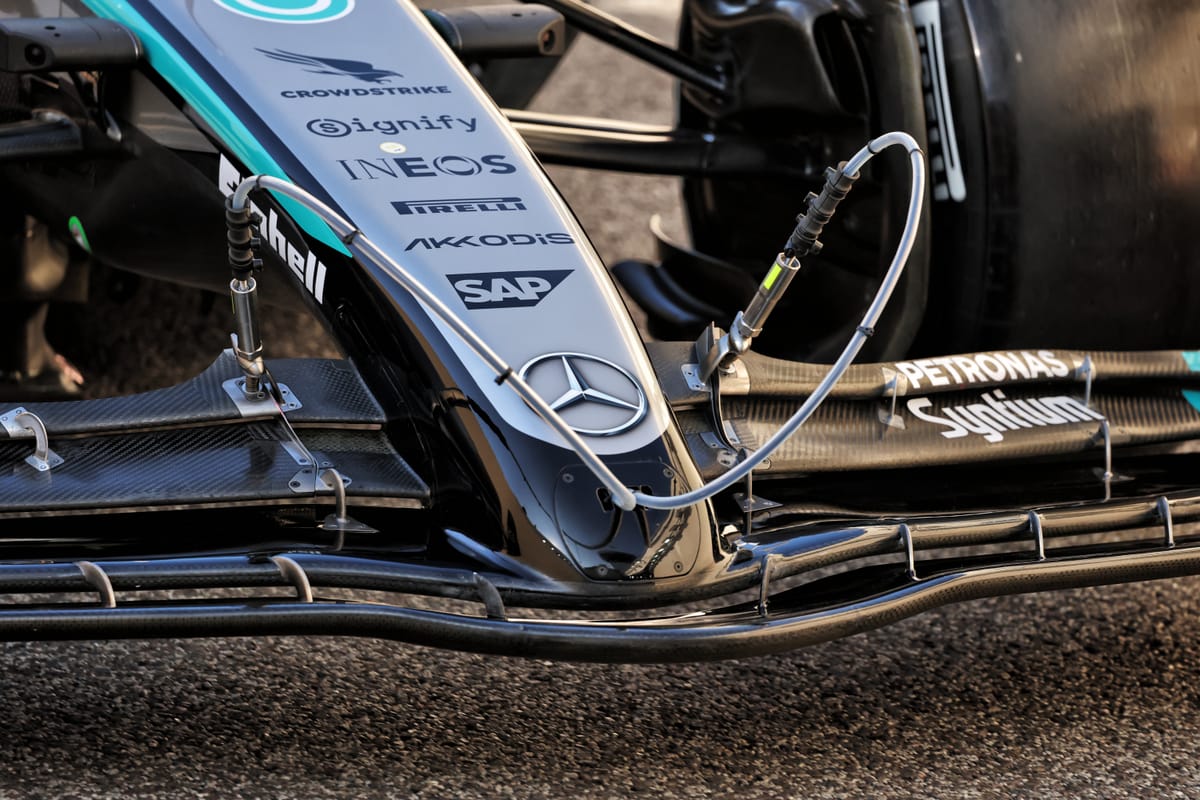
Mercedes was the first to show its hand, debuting a prototype that was, by comparison, raw and rudimentary. Their method for activating the adjustable front wing hinted at a complex, interlinked system. To activate the wing’s low-drag mode, the team had to use a set of visible, specific tubes protruding from the nose cone and channeling air into the front wing structure. This system appears to be directly connected to the car’s overall low-drag philosophy, likely designed to correlate data with the adjustable rear wing, giving the driver a system akin to a ‘double DRS,’ though operating under a different principle.
The visual simplicity—or lack of refinement—of the Mercedes setup suggests the team was primarily focused on data correlation rather than aerodynamic cleanliness. It was a clear, mechanical proof-of-concept. Engineers needed to understand precisely how the airflow responded to their activation mechanism. However, its unpolished appearance instantly raised questions about its eventual aerodynamic efficiency. While a necessary step in the development cycle, it served as a stark contrast to the approach taken by their most immediate rival.
Ferrari: The Sophisticated, Integrated Solution
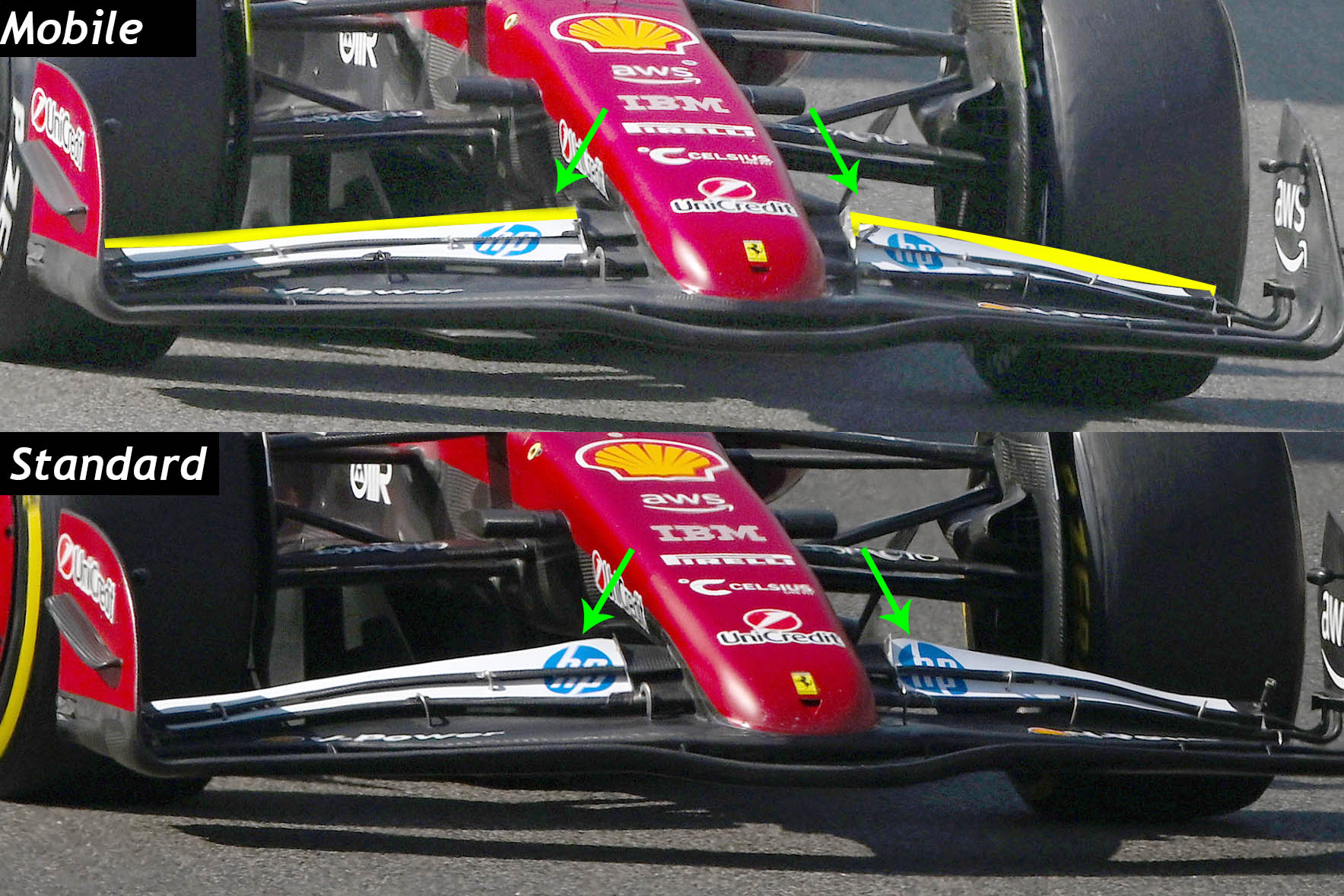
Ferrari’s prototype, also tested in Abu Dhabi, immediately showcased a far more advanced and elegant interpretation of the new rulebook. Where the Mercedes wing required external appendages and exposed tubes, Ferrari had completely integrated its activation mechanism. The system was housed seamlessly underneath the front wing, on the back side of the main elements.
This sophistication speaks volumes about the maturity of Ferrari’s development program. By burying the mechanism, they immediately bypass the inherent aerodynamic drag penalties that the Mercedes design appears to invite. More importantly, an integrated solution allows for cleaner airflow management, translating into more accurate and higher-quality correlation data from the test. This early refinement suggests Ferrari is not merely exploring the rules; they are already optimizing them, indicating an aggressive confidence in their aerodynamic pathway for the future of Formula 1.
The Shocking Leak: Cadillac’s Aggressive Triple Threat
While Mercedes and Ferrari were deliberately releasing controlled glimpses, the most comprehensive and revealing view was provided by an entirely unintended source: the Cadillac/Andretti program. In a remarkable oversight by an editor on their own YouTube channel, a video clip was aired that failed to blur out an image of what appeared to be three different prototype front wings. This was not a single concept car; this was proof of a multi-pronged, aggressive design strategy.
The leak offered an in-depth, high-resolution look at the extreme measures being taken. All three Cadillac variations shared a core design philosophy centered on outwash. Outwash is the aerodynamic practice of pushing turbulent air from the front tires out and around the car, rather than letting it be sucked underneath the floor. This is a crucial area of focus for the FIA’s new rules, which aim to minimize the “front tire wake” and allow cars to follow each other more closely—the holy grail of closer racing.
The Cadillac designs featured distinct camber and unique strakes (small aerodynamic fences) just above the footplate, all configured to promote maximum outwash. Furthermore, the collection of wings was mounted on a display that showcased completely different nose cone shapes. This confirmed a fundamental truth of F1 development: the front wing and the nose are inseparable. Teams must iterate through numerous combinations of both to find the single most efficient setup. The fact that Cadillac, an incoming competitor, is already this far down the developmental rabbit hole—testing multiple philosophies on what is likely a 60% scale model—is a powerful statement of their intent and the depth of their engineering commitment. The revelation of these three prototypes demonstrates that Cadillac is leaving no stone unturned in preparing a car that will be competitive from day one.
The Cockpit Revolution: Hamilton and the Hypercar Link
The revolution is not confined to the car’s exterior. Ferrari also introduced a significant change inside the cockpit, debuting a radical new prototype steering wheel. This component, the driver’s most intimate interface with the machine, signals a complete reset of the human-car interaction.
The prototype steering wheel is visibly altered from its current counterpart. It features a redesigned layout, changes to button placements, and a significantly larger, more advanced LED display. At first glance, some analysts drew parallels to the steering wheel used by Lewis Hamilton during his dominant era at Mercedes, particularly regarding the rotary switches. Hamilton’s Mercedes wheels were known for their elegant simplicity, featuring only three main rotary switches. The current Ferrari wheel, by contrast, had six. The new prototype? It has been reduced to just three, instantly aligning it with Hamilton’s preference. While Hamilton will officially join the Scuderia in the near future, this rapid design shift on a key component suggests his influence is already profoundly reshaping the team’s philosophical approach to the cockpit, prioritizing a setup he finds familiar and efficient.
However, the real shock lies in the steering wheel’s ultimate design source. Upon closer inspection, it became clear the design was not just inspired by Mercedes; it was a near-identical convergence with another Ferrari racing program: their Le Mans 24 Hours Hypercar.
Ferrari’s decision to port the design and overall layout of their world-class endurance Hypercar steering wheel directly into their F1 machine is a strategic masterstroke. Hypercar racing requires extreme efficiency, reliability, and driver focus over grueling, 24-hour periods. By adapting this design, Ferrari is bringing the robust, uncluttered, and highly efficient ergonomics of endurance racing into the sprint format of F1. This crossover reflects a willingness to borrow successful design language from across their entire motorsport portfolio, potentially giving their drivers a tangible advantage in an era where cockpit complexity is only increasing.
The revelations from Abu Dhabi and the unexpected leak have made one thing perfectly clear: the future of Formula 1 is not a distant event; it is a battle that has already begun in secret testing grounds and obscured computer simulations. With Mercedes playing a deliberate, basic hand, Ferrari displaying calculated, integrated sophistication, and the incoming Cadillac team staking a claim with an aggressive, multi-variant approach, the early signs point to a technological arms race that will define the sport for the next half-decade. The stakes are immense, the secrecy is paramount, and the first glimpses confirm the F1 grid will look, feel, and drive like nothing we have ever witnessed.
