The sun was already dipping low over the Circuit de Barcelona-Catalunya, casting long shadows across the asphalt. In the grandstands, the few remaining spectators were packing their bags. In the media center, journalists were already filing their “final” reports, summarizing a largely uneventful and technically heavy week of Formula 1 pre-season testing. The narrative seemed set: a quiet year of consolidation, with teams hiding their true pace.
But down in the Ferrari garage, the day was far from over.
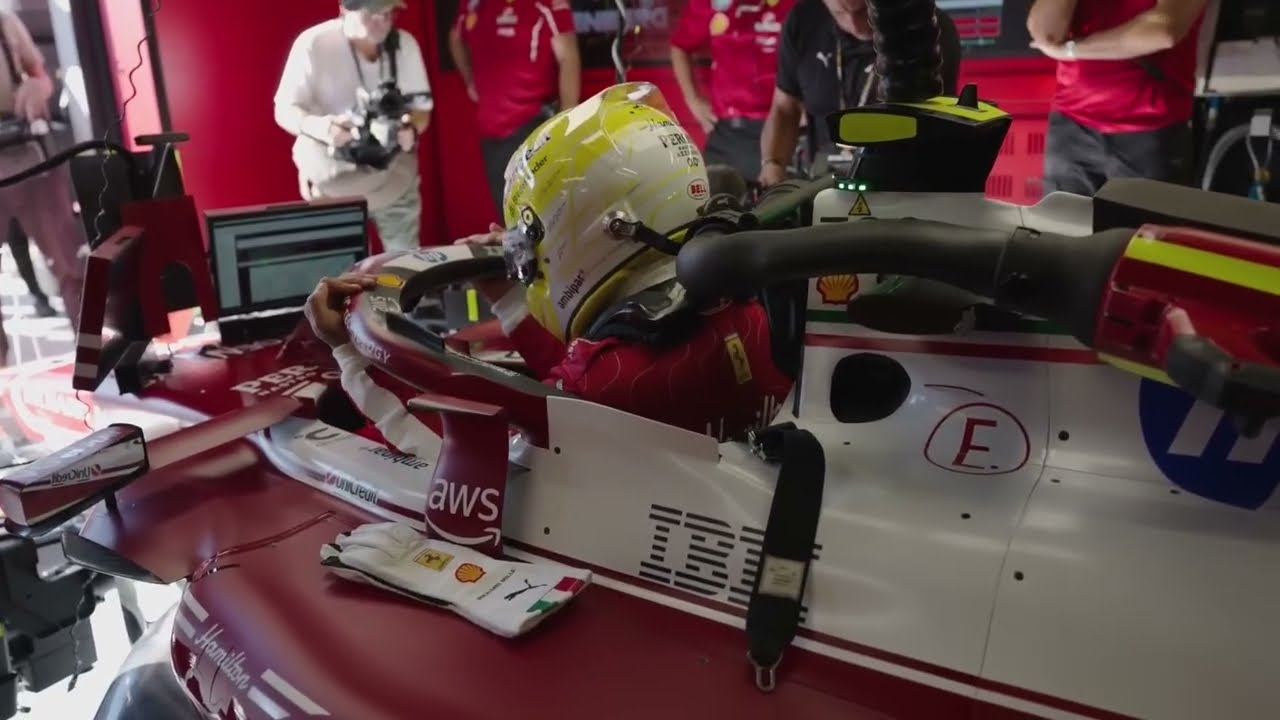
While the rest of the paddock was winding down, convinced that no surprises were left to be unveiled, the Scuderia was preparing to light the fuse on what can only be described as a silent revolution. What followed in the next few minutes didn’t just top the timing charts; it sent a shiver down the spine of every rival team principal on the pit wall. Lewis Hamilton, behind the wheel of the SF26, didn’t just drive a car—he delivered a manifesto.
The Art of Deception
For five long days, Ferrari had played the role of the sleeping giant perfectly. There were no glory runs, no purple sectors to light up social media, and absolutely no headlines. Team Principal Fred Vasseur had been explicitly clear from day one: the goal was validation, not vanity.
The team spent the majority of the week obsessed with the unsexy side of Formula 1: correlation. They cross-referenced wind tunnel data with on-track telemetry, verified simulator models, and stress-tested the reliability of the new 350 kW MGUK system. It was methodical, boring, and crucially, it lulled their rivals into a false sense of security. Competitors had shown their hands early, setting fast times on days two and three, believing they had the measure of the field.
Ferrari waited. They knew that track evolution is a powerful tool. By late Friday afternoon, the rubber laid down over five days of continuous running had created a surface with maximum grip. The air temperature was cooling, increasing engine density. The conditions were ripe for a “clean blow,” a strike executed when everyone else was distracted, deprogramming their qualifying simulations to save engine life.
The Lap That Changed the Narrative
At precisely the right moment, the garage doors opened. The SF26 emerged, not in race trim, but in full qualifying configuration. The fuel load was minimal. The engine map was turned up to its most aggressive setting. The tires were a pristine set of soft C3s.
Hamilton’s out-lap was calm, almost predatory. But as he crossed the line to start his flyer, the intensity shifted instantly.
1:16.348.
When those numbers flashed on the timing screens, they didn’t just represent the fastest time of the week. They represented a paradigm shift. To the casual observer, it’s just a stopwatch reading. To the engineers staring at telemetry screens in the Red Bull and Mercedes garages, it was a siren.
This wasn’t a “glory run” born of luck or desperation. It was a surgical dissection of the circuit. In Turn 1, Hamilton held the brake pedal until the absolute last millisecond, transferring the lateral load to the front axle with a violence that would have unsettled previous Ferrari chassis. The SF26 didn’t flinch. There was no understeer, no nervous correction, and crucially, no aerodynamic stalling. The car remained planted and neutral, obedient to the seven-time champion’s every input.
Technical Mastery: The SF26 Revealed
The middle sector revealed the true genius of the new design. The entrance to Turns 4 and 5 has historically been a weakness for the Scuderia, a place where traction is often compromised by rear instability. Not this time. The new front push-rod suspension, working in harmony with a redesigned axle geometry, allowed Hamilton to get back on the power instantly. The traction was immediate and clean, devoid of the wheelspin that bleeds precious tenths.
But the real showstopper was the back straight.
2026 brings with it the complex challenge of active aerodynamics replacing traditional DRS. If this system isn’t perfectly synchronized with the electrical deployment of the hybrid engine, it creates drag and inefficiency—a technical nightmare known as “clipping.”
Hamilton activated the low-drag mode as the SF26 hit 290 km/h. Simultaneously, the MGUK unleashed its full 350 kW boost. The transition was seamless. There was no jolt, no loss of power, just a relentless, linear surge of acceleration. It was a “technical orchestra” playing in perfect unison, blending aerodynamic efficiency with raw hybrid aggression.
Beyond the One-Lap Wonder
If the 1:16.348 was the hook, what followed was the knockout punch. Hamilton didn’t return to the pits to high-five his mechanics. He stayed out.
He proceeded to reel off a series of laps in the low 1:16s and high 1:17s. In the world of F1 testing, this consistency is far more terrifying than raw speed. It indicates a “wide operating window”—the holy grail of car design. It means the SF26 isn’t a diva that only works when the track temperature is exactly 30 degrees and the wind is blowing south. It means the car is predictable, controllable, and fast across a variety of conditions.
For a driver like Hamilton, this is everything. It allows him to focus on racing rather than fighting the machine. The telemetry showed no overheating peaks in the brakes, the rear differential responded precisely to tire wear, and the hybrid system—which had caused headaches in 2025—didn’t register a single anomaly.
The End of the Correlation Curse?
Perhaps the most significant takeaway from that Friday afternoon in Barcelona is intangible. It’s the death of a ghost that has haunted Maranello for years: the correlation gap.
In 2022 and 2023, Ferrari often brought upgrades that looked brilliant in the wind tunnel but failed miserably on the asphalt. They generated unexpected bouncing, tire degradation, or aerodynamic imbalances. This disconnect paralyzed development, forcing the team to spend weekends fixing problems rather than chasing performance.
The data from Hamilton’s final run aligned “almost to the millimeter” with the predictions from the simulator back in Italy. This validation is worth more than any trophy. It means that when Ferrari designs an upgrade in June, they can be confident it will work in July. It means their development curve for the 2026 season can be aggressive and sustained, a crucial factor in the modern championship fight.
A Letter of Intent
As the engines finally fell silent and the sun set on the pre-season, the mood in the Ferrari hospitality unit had shifted from cautious optimism to quiet confidence. They hadn’t just tested a car; they had proven a philosophy.
Lewis Hamilton wasn’t just shaking down a new chassis. By waiting until the final moment, when eyes were turning away, and delivering a lap of such devastating perfection, he was signing a letter of intent. He has fused with the car, adapted his braking style, and found a machine that finally speaks his language.
The 1:16.348 was a message to the rest of the grid: The silent revolution has begun, and Ferrari is no longer interested in just participating. They are here to dominate.
