The dust has barely settled on the Bahrain International Circuit following the conclusion of Formula 1’s highly anticipated pre-season testing, yet a profound sense of unease is already rippling through the paddock. The numbers emerging from the timing screens and GPS traces are not just encouraging for Scuderia Ferrari; they are deeply unsettling for their fiercest competitors, namely the Mercedes AMG Petronas and McLaren Formula 1 teams. According to detailed, behind-the-scenes analysis of pre-season telemetry, Ferrari’s brand-new SF-26 challenger possesses what paddock insiders are describing as an earth-shattering advantage in mechanical grip and low-speed traction.
In a sport where championships are often decided by microscopic margins, this single, devastating trait threatens to completely alter the competitive hierarchy of the 2026 season. But the most extraordinary part of this unfolding drama is not just the speed itself. The car that Ferrari used to reveal this terrifying advantage in the desert may not have even been their real championship contender.
To truly understand the magnitude of this engineering masterstroke, we must first look backward and acknowledge the emotional and historical weight driving the team from Maranello. The 2025 campaign was, by all metrics, a catastrophic collapse for the most storied franchise in motorsport.
The previous iteration of their car, the SF-25, promised a glorious evolution but ultimately delivered nothing but bitter frustration. It yielded zero victories. Most shockingly, it resulted in zero podiums for seven-time World Champion Lewis Hamilton. For the first time in his legendary career, Hamilton endured a complete drought, visibly wrestling with an unpredictable, unstable machine that entirely eroded his confidence.
Recognizing that the core architecture of the 2025 car was fundamentally flawed, Ferrari management made a brutally painful but ultimately brilliant strategic decision. They abandoned the development of the SF-25 astonishingly early in the season, willingly sacrificing a year of results to redirect all their financial resources and engineering brainpower entirely toward the sweeping regulation changes of 2026. That agonizing decision bought the team the most priceless commodity in Formula 1: time. They gained eight uninterrupted months to completely rethink their aerodynamic philosophy, internal packaging, and engine architecture.
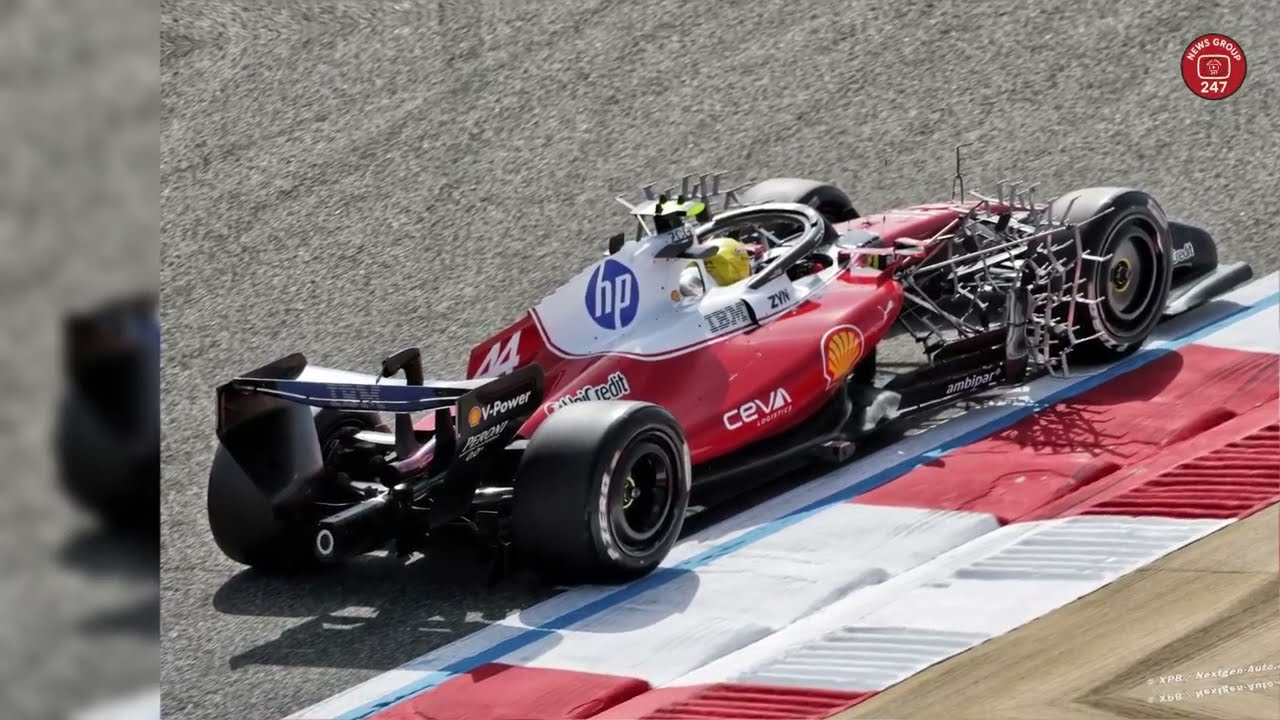
When the SF-26 finally rolled out of the garage for the first time in Barcelona and subsequently in Bahrain, it did not immediately scream domination. The lap times were undeniably strong, but they lacked the theatrical, headline-grabbing ultimate pace that usually signifies a championship favorite. To the untrained eye, and even to some seasoned rival aerodynamicists, the red bodywork looked surprisingly bulky, perhaps even conservative.
However, this was an elaborate, beautifully executed trap. The oversized sidepods that raised eyebrows up and down the pit lane were never actually intended to go racing. Ferrari had effectively brought a “fake” car to the test. Those swollen flanks were deliberate thermal mapping rigs—an intentional overcompensation designed to gather critical cooling data in absolute safety. Ferrari was running zero centerline cooling, choosing instead to place every single radiator inside those massive sidepods rather than along the traditional spine of the car. This left the airbox astonishingly tiny, the smallest on the entire grid, hinting at a much more aggressive aerodynamic concept waiting in the wings.
Sources deeply embedded within the team suggest that the true, final specification of the car destined for the season opener in Melbourne will feature dramatically tighter, shrink-wrapped bodywork. This breathtaking aerodynamic redesign is enabled by a massive, fiercely guarded secret buried deep within the heart of the SF-26: a radical internal choice regarding the power unit.

While every other engine manufacturer on the Formula 1 grid—from Mercedes to Red Bull to Honda—continues to utilize traditional aluminum cylinder heads, Ferrari alone has made the massive gamble to commit to steel cylinder heads for their 067/6 power unit. To a casual observer, swapping aluminum for steel might sound like a minor metallurgical footnote. In the hyper-complex realm of modern Formula 1 engineering, it is an absolute revolution.
Steel naturally tolerates significantly higher combustion pressures and extreme temperatures compared to aluminum. Crucially, it insulates heat far more effectively. By keeping the explosive energy trapped within the combustion chamber instead of allowing it to bleed outward into the engine bay, the power unit generates vastly more power while simultaneously rejecting less heat. Less heat escape translates directly to a dramatically reduced demand for cooling. Less cooling demand allows the team to utilize significantly smaller radiators. Smaller radiators are the holy grail for aerodynamicists, as they permit the design of incredibly tight, heavily sculpted sidepods.
This is where the genius of the steel cylinder head truly pays off. Tighter sidepods drastically improve the volume and quality of airflow directed toward the floor of the car. In the current ground-effect era of Formula 1, the floor is responsible for generating the vast majority of the car’s downforce. A highly efficient floor completely defines the rear stability of the vehicle. Therefore, Ferrari’s traction advantage is not the result of a simple bolt-on suspension upgrade; it is the culmination of a deeply integrated, systemic engineering philosophy. The engine dictates the cooling, the cooling dictates the bodywork, the bodywork dictates the aerodynamics, and the aerodynamics deliver the immense mechanical grip.
The terrifying reality of this grip was quietly exposed in the micro-sectors of the Bahrain telemetry data. At Turn 1, a notoriously difficult traction zone, Charles Leclerc was reportedly able to apply full, uncompromised throttle an astonishing five meters earlier than his closest rivals. By the time he navigated the tight hairpin of Turn 10, that margin had extended to nearly seven meters. In Formula 1 terms, seven meters is not a marginal gain; it is a seismic event. The sheer rear stability of the SF-26 allowed both Leclerc and Hamilton to commit to the throttle not tentatively or with caution, but with immediate, violent decisiveness. Over the course of a 300-kilometer race distance, those extra meters of acceleration compound into tenths of a second. Tenths become seconds, and seconds become dominant victories. While McLaren might possess comparable average acceleration once their car is fully deployed down a straight, it is the initial instant of power application—the launch out of the corner—where Ferrari has struck absolute gold.

The psychological impact of this breakthrough on the drivers is impossible to overstate. After twelve glorious years driving for Mercedes, Lewis Hamilton’s transition to Ferrari in 2025 was a brutal baptism by fire. The profound instability of last year’s car eroded his trust, and in a sport that demands absolute commitment, hesitation is the enemy of speed. Now, that hesitation has vanished completely. During practice starts in Bahrain, the SF-26 looked explosive, repeatedly leaping forward with a ferocity that left onlookers speechless. Both Hamilton and Leclerc have reported that the new car responds faithfully to their inputs, communicating exactly what it is going to do rather than delivering nasty, mid-corner surprises.
The most frightening aspect for the rest of the grid is that this advantage is virtually uncopyable in the short term. Could Mercedes or McLaren simply rush a similar upgrade to their cars? The answer is a resounding no. The steel cylinder head architecture is a foundational design choice. Attempting to replicate it would demand a complete, ground-up redesign of the engine block, massive manufacturing shifts, and exhaustive durability validation. It is a process measured in many months, not weeks. A mid-season replication is physically and logistically impossible. Furthermore, the 2026 regulations actively softened the traditional weight penalty associated with heavy steel by raising the minimum allowable mass for the power units, effectively absorbing the difference. Ferrari took a massive conceptual gamble, and the new rulebook quietly rewarded their bravery.
While Ferrari was busy validating this revolutionary concept, they masterfully distracted the media and their rivals with other visual tricks. They debuted a clever exhaust wing designed to redirect hot gases to energize the rear airflow, and a highly theatrical rotating rear wing that reportedly delivered a massive top-speed gain on the straights. The spectacle consumed the paddock’s attention. Cameras zoomed in on the flexing carbon fiber, while the true revolution was quietly unfolding deep within the engine cover and along the tightly packaged flanks of the car.
All roads now lead to the Albert Park circuit in Melbourne, a track that demands exactly what the SF-26 possesses in abundance. Melbourne features heavy braking zones, rapid direction changes, and requires excellent low-speed traction to launch down the circuit’s multiple straights. Historically, Ferrari thrives in Australia, boasting eleven victories at the venue. If the true, tightly packaged Melbourne-specification bodywork delivers the aerodynamic step that Ferrari’s supercomputers predict, the iconic Italian team will arrive not merely as competitive front-runners, but as an incredibly dangerous, dominant force.
Of course, a degree of caution must always be maintained. Pre-season testing is notorious for its deceptions. Mercedes is widely believed to have masked their ultimate performance, running heavy fuel loads and conservative engine maps. McLaren’s relentless mid-season development pace over the past two years cannot be dismissed, and Red Bull’s aggressive energy deployment strategies remain a formidable threat.
However, structural engineering advantages are much harder to dismiss than simple headline lap times. The traction gains witnessed in Bahrain are measurable, quantifiable facts. The mechanical grip is visible to anyone analyzing the onboard footage. The integration of the engine and the aerodynamics is deliberate and masterful. The SF-26 is not just a fast car; it appears to be a brilliantly cohesive weapon. When the five red lights go out in Melbourne, the theoretical data will transform into harsh reality, and those precious meters gained out of the corners in Bahrain may very well echo all the way to a World Championship.
