In the hallowed halls of Maranello, silence is heavy. It is weighted with the ghosts of champions who came to conquer and left broken—Sebastian Vettel, Fernando Alonso, Alain Prost. Now, Lewis Hamilton walks these same corridors, draped in Ferrari red, carrying the hopes of a nation and the burden of his own legacy.
But behind the carefully curated press releases and the smiles in Barcelona, a storm is brewing. The partnership that was supposed to rewrite Formula 1 history is facing a terrifying paradox that could either resurrect the Scuderia or end Hamilton’s career in frustration.
As the 2026 season looms—a year of massive regulation changes and clean slates—insiders are whispering that the reality inside the Ferrari garage is far more complex, and perhaps far more dangerous, than the public realizes.

The Shadow in the Technical Area
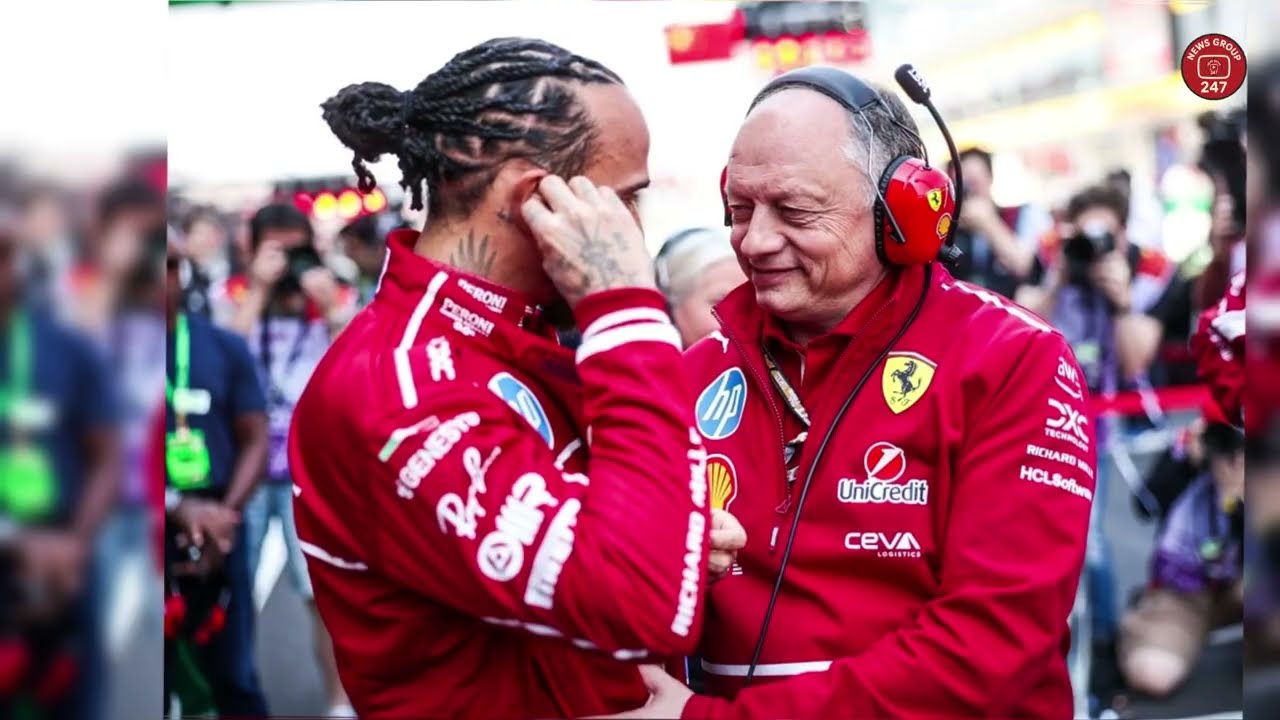
The first crack in the façade appeared not on the track, but in the quiet corners of the paddock. During the recent shakedown, observers noted a pivotal moment involving Hamilton and his interim race engineer, Carlos Santi. It wasn’t a standard debrief. There was no shouting, no hand-waving. Instead, Hamilton spoke with a quiet intensity, a “plea” for reassurance.
“He wanted reassurance from the team, from the paddock, from the fans, from himself,” sources suggest.
Why would the seven-time world champion, the most successful driver in history, need reassurance? Because he knows what he has walked into. Ferrari is not just a racing team; it is a belief system. And as Alex Brundle, son of F1 legend Martin Brundle, pointed out with surgical precision: “Ferrari does not acknowledge failure as a concept.”
This “win or nothing” creed is intoxicating when things are going well, but it is suffocating when they are not. Hamilton is coming off a bruising 2025 campaign—sixth in the standings, zero wins, and a crushing points deficit to teammate Charles Leclerc. He is vulnerable. And Ferrari’s culture, historically, does not nurture vulnerability; it demands immediate perfection.
The Engineering Mismatch
The concern goes deeper than psychology. There are growing fears of a fundamental mismatch between Hamilton’s driving style and Ferrari’s engineering philosophy.
Hamilton thrives on chaos. He is a master of the “imperfect machine,” a driver who likes a rear end that dances on the limit, allowing him to wrestle the car into corners and extract lap times that shouldn’t exist. It’s how he won in the rain in Turkey; it’s how he dominated for a decade.
Ferrari, however, builds for control. Their engineering DNA favors stability, predictability, and rigidity. They design cars that are mathematically correct but often clinically stiff. Brundle warns that this “cultural inertia” could mean the SF26 is already fighting Hamilton’s natural instincts before a wheel is even turned in anger.
“Is Ferrari willing to bend for Lewis Hamilton, or does Ferrari believe Ferrari itself must never bend?” This is the multi-million dollar question. If the team expects Hamilton to simply adapt to a car that contradicts his muscle memory at age 41, the dream partnership could dissolve into a nightmare of spin-outs and mid-field finishes.

The “Wild Card” Upgrade
However, where there is risk, there is also potential for a miracle. While the skeptics worry about the chassis, rumors from Italy suggest that Ferrari is holding a “Wild Card” that could blindside the competition.
Reports indicate that Maranello is planning a significant, radical upgrade before the season opener in Australia. The secret lies in the power unit. Ferrari has reportedly opted for a bold engineering choice: using steel cylinder heads in their internal combustion engine.
This might sound like dry technical trivia, but the implications are explosive. Steel handles heat better than aluminum. Better heat management means the engine runs hotter but dissipates that heat more efficiently. This allows for smaller radiators. And smaller radiators mean the design team can shrink the sidepods.
The “Slimmer” Secret
In modern F1, sidepods are the “lungs” of the car. By shrinking them, Ferrari can unlock massive aerodynamic freedom. Cleaner airflow to the rear wing means more downforce without the drag penalty. It means higher top speeds and better cornering grip.
If these rumors are true, Ferrari hasn’t just built a new car; they’ve built a trap. Rivals like Red Bull and McLaren have spent the winter modeling their cars based on standard cooling requirements. If Ferrari shows up in Melbourne with a sleeker, tighter, more aerodynamic package that physically shouldn’t be possible with standard engines, they could catch the entire grid napping.
This is the “free performance” Hamilton desperately needs. It’s the kind of technical unfair advantage that defined his Mercedes era. If the car has raw speed, Hamilton can work around the handling issues. But if the car is slow and difficult to drive, the project is dead on arrival.
Redemption or Retribution?
The 2026 regulations are the great equalizer. They represent a reset button for the sport, and for Hamilton, they represent one final roll of the dice. He is 41 years old. He doesn’t have time for a “transition year.” He doesn’t have time for Ferrari to “learn.”
The narrative is set on a knife-edge. On one side, you have the crushing weight of Ferrari’s history—a team that eats its own legends when they fail to deliver. On the other, you have the potential for the greatest comeback story in sports history: the aging king, armed with a radical “steel-hearted” engine, silencing the doubters one last time.
As the paddock prepares for the lights to go out in Bahrain, everyone is watching the timesheets. But the real story isn’t the lap time; it’s the body language. Is Hamilton smiling because he’s happy, or is he smiling because he’s hiding the fact that he’s terrified?
The SF26 is coming. It might be a masterpiece, or it might be a monster. And for Lewis Hamilton, there is no middle ground. It really is win, or nothing.
